A leaf with legs. A plant that looks like a stone. A person whose outline disappears into grass. Camouflage shapes what we notice and recognise. Explore the collection through three different observers: nature, humans and AI.
20 examples across three sections. Choose a section below.
Animals and plants can escape an animal observer’s attention through background matching, broken outlines, masquerade, changing appearances or borrowed cover. Explore the natural adaptations that make a living thing harder to spot or recognise.
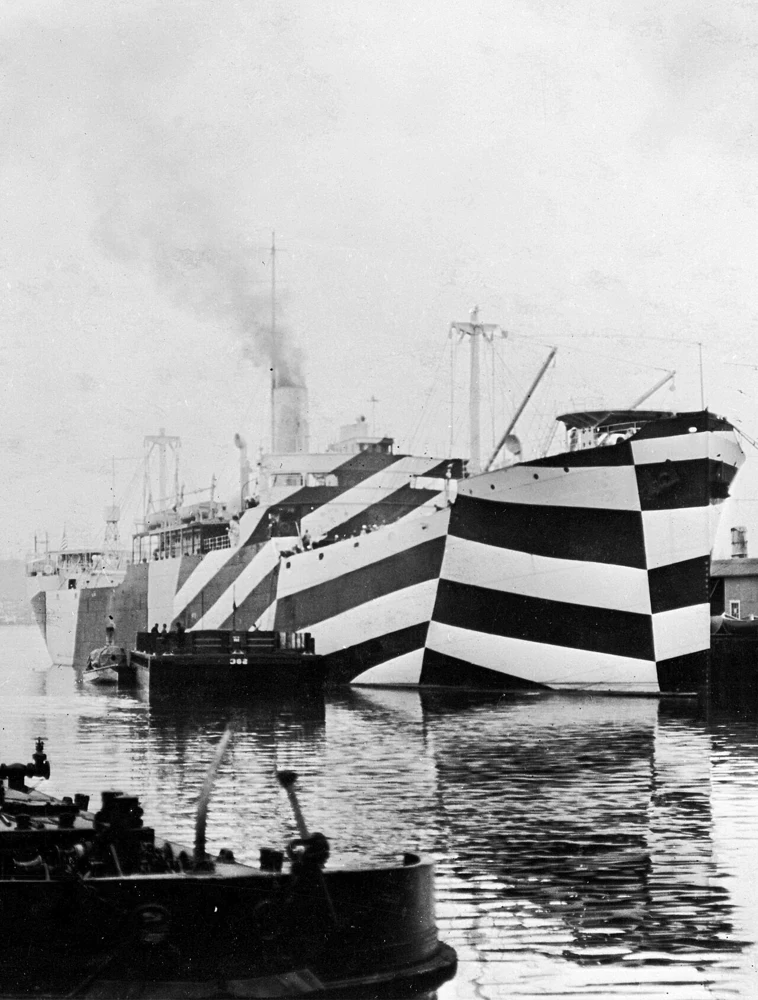
People design clothes, paint and structures to change what another person sees. Ghillie suits, face paint and netting soften familiar outlines; disguised observation posts encourage misidentification; dazzle ships confuse judgments of shape and direction.
Image: Photographer not identified; Bureau of Ships Collection, US National Archives · Source · Public domain. Commons size rendition; viewing previews may be resized.Explore section →
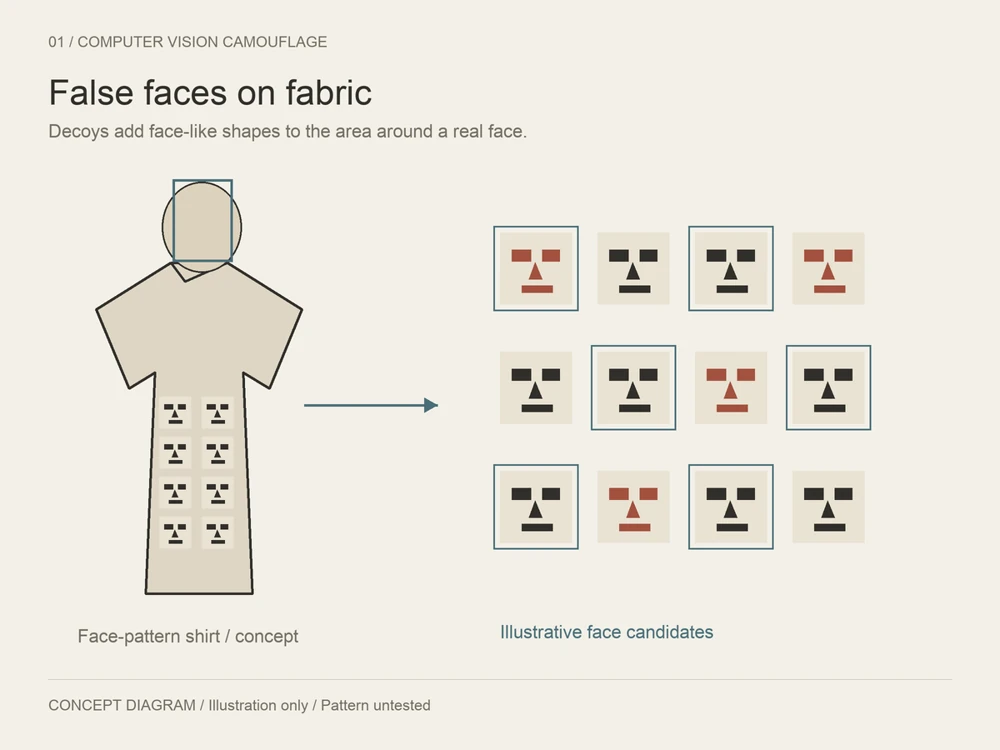
Clothing and facial patterns deliberately challenge a computer vision model. False faces on fabric, adversarial shirt prints, all-over garment textures and graphic makeup target different steps in machine perception.
Image: Through Mirror — original explanatory diagram · Source · CC0 1.0. Original concept illustration; pattern untested; viewing previews may be resized.Explore section →
Match a background
Reduce differences in colour and texture. Bark, snow or pebbles can make an outline harder to find.
Break up an outline
Contrasting patches and irregular edges interrupt the continuous boundary we use to recognise a body.
Be mistaken for something else
Masquerade lets a visible organism or object pass as a leaf, a stone, seaweed or an ordinary tree.
Change the appearance
Some animals alter patterns or transparency. Seasonal coats change more slowly, by growing new fur or feathers.
Borrow the surroundings
Decorator crabs attach cover to their shells. Human clothing and netting also add material and texture.
Confuse interpretation
Dazzle patterns target judgments of a ship’s direction. Face decoys and adversarial clothing target how particular computer vision systems interpret an image.
Frequently asked questions
What is camouflage?
Camouflage changes how an observer detects or recognises an organism or object. It includes matching a background, breaking up an outline, masquerading as something else, borrowing cover and confusing judgments of shape or direction.
Is camouflage only found in animals?
No. Plants such as Lithops resemble stones. People use camouflage in clothing, face paint, netting, disguised structures and painted ships. Some designs also challenge how computer vision models detect people or faces.
What is the difference between background matching and masquerade?
Background matching reduces the visual contrast between an object and its surroundings. Masquerade makes an object resemble something the observer may ignore, such as a leaf, a stone or a tree.
Does dazzle camouflage make a ship invisible?
Dazzle patterns were intended to confuse judgments of a ship’s form and course while it remained visible. Their historical effectiveness is difficult to establish; they are different from background matching.
Does camouflage work equally well everywhere?
No. Visibility depends on the background, light, distance, movement and the observer’s sensory abilities. A photograph illustrates appearance but does not establish effectiveness in every setting.
Can face patterns on a shirt confuse facial recognition?
Face-like prints can act as decoys for a specific face detector, as explored by HyperFace. The original prototype used a scarf and targeted an older OpenCV detector. Producing false face detections does not prove that the real face is missed or that its identity cannot be matched. A generic face-pattern shirt has no established protective effect.
How do adversarial shirts differ from face-pattern clothing?
HyperFace adds face-like decoys around a person. Adversarial shirt research designs prints to change a person detector’s decisions; those prints need not resemble faces. Some studies use a chest patch, while others cover shirts, skirts and dresses with an all-over texture.
What is the difference between face detection and face recognition?
Face detection locates a face in an image. Face recognition compares a face with stored identities. Person detection locates the whole person. Confusing one of these tasks does not by itself establish that the other tasks have failed.
Does computer vision camouflage work against every AI model?
No universal effect is established by these examples. Results depend on the target model, camera viewpoint, movement, lighting and fabric deformation. The original HyperFace and CV Dazzle looks targeted older face detectors. The diagrams here explain the ideas and are not tested camouflage patterns.