People design clothes, paint and structures to change what another person sees. Ghillie suits, face paint and netting soften familiar outlines; disguised observation posts encourage misidentification; dazzle ships confuse judgments of shape and direction.
5 illustrated examples. Follow each disguise to its full entry, image and sources.
Tricking humans
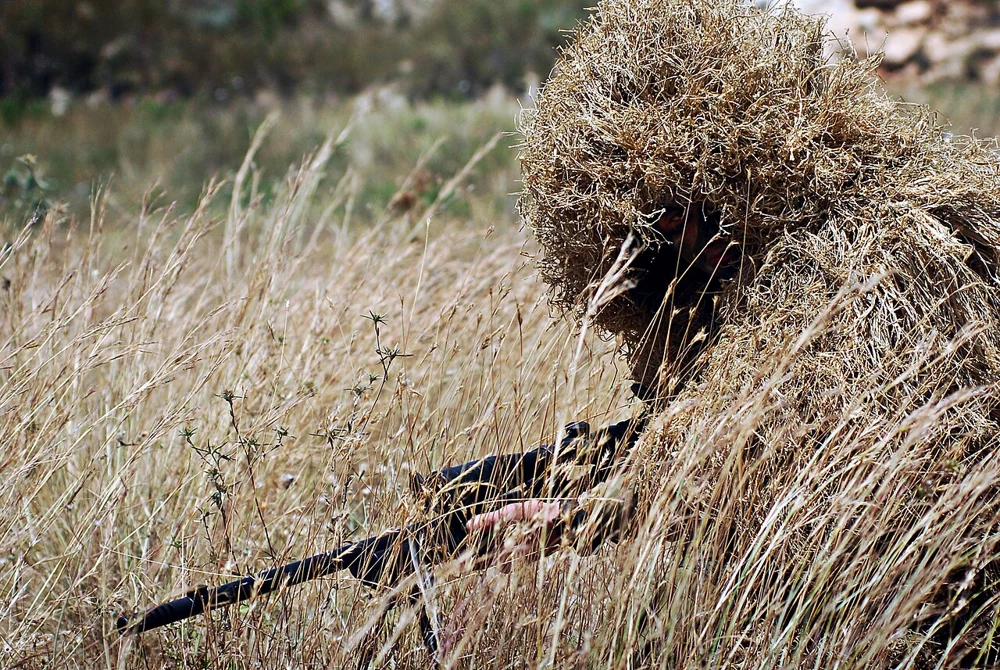
Camouflage suit demonstrated at Mitkan Adam in 2009; photograph by Michael Shvadron, IDF Spokesperson Unit. Image: Michael Shvadron, IDF Spokesperson Unit · Source · CC BY 2.0. Commons size rendition; viewing previews may be resized.
01 / Texture, self-decoration and silhouette
Ghillie Suit — Borrowing Nature’s Texture
Camouflage clothing; photograph by Michael Shvadron · Clothing against vegetation
Loose fibres soften the recognisable outline of a human body.
Ghillie suits bring camouflage into clothing. The Smithsonian’s National Museum of American History holds a suit whose layered fibres and added vegetation illustrate the relationship between colour, texture and concealment.
An ordinary jacket leaves a clear shoulder, head and arm outline. Irregular fibres add texture and make those boundaries less continuous. Their appearance works together with the surrounding vegetation, much as attached cover does on a decorator crab.
LOOK FOR THE DISGUISE
Find the head above the dark opening and follow the shoulder into the grass. Notice how the fibres obscure the boundary between clothing and surroundings.
The photograph and the Smithsonian collection record show different suits. The effect depends on the background, light and observer.
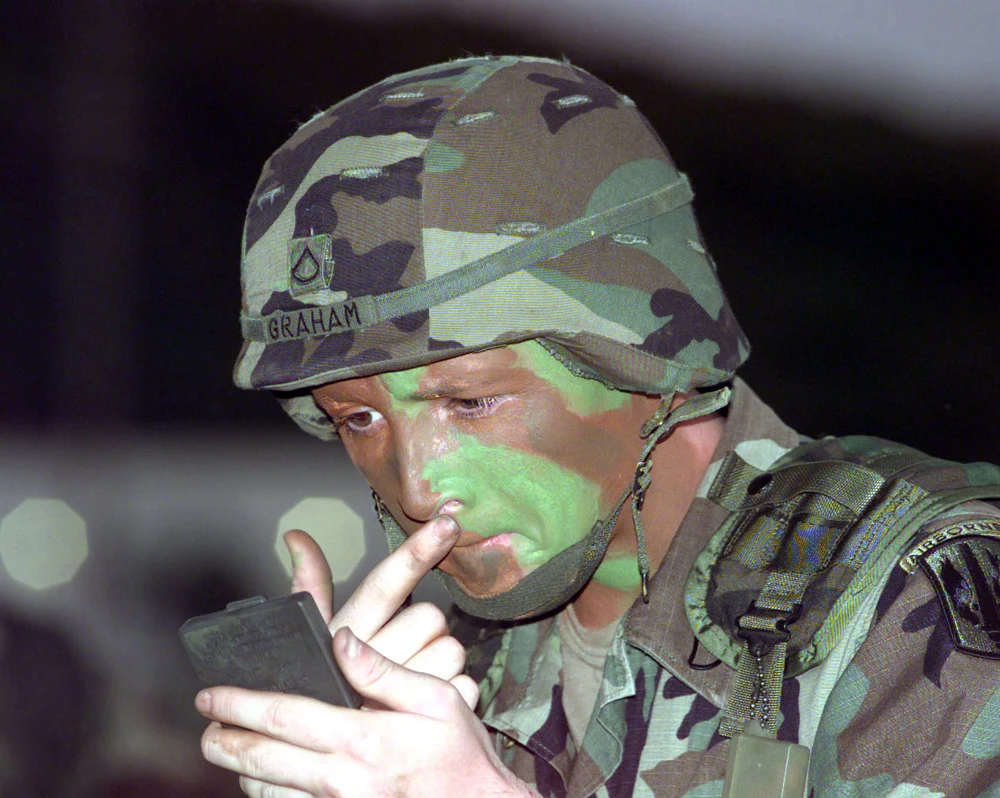
PFC Joel Graham applying camouflage paint before an exercise; US military photograph by SPC Gerald James. Image: SPC GERALD JAMES · Source · Public domain. Commons size rendition; viewing previews may be resized.
02 / Colour and disruptive pattern
Face Paint — Interrupting a Familiar Face
Camouflage face paint; photograph by SPC Gerald James · Human skin and clothing
Paint changes the contrast and familiar visual pattern of exposed skin.
Human camouflage extends beyond patterned fabric. The US Army’s equipment record describes face paint applied to exposed skin as a way to reduce detection in visible and near-infrared light.
Colour patches can reduce the contrast of exposed skin against clothing and surroundings, and interrupt the cues by which an observer recognises a face. A photograph in visible light cannot establish how the materials appear in infrared.
LOOK FOR THE DISGUISE
Compare the painted face with the patterned helmet. Notice which edges, eyes and highlights still reveal the person.
This photograph shows application in progress. It illustrates colour and visible contrast, rather than measuring concealment.
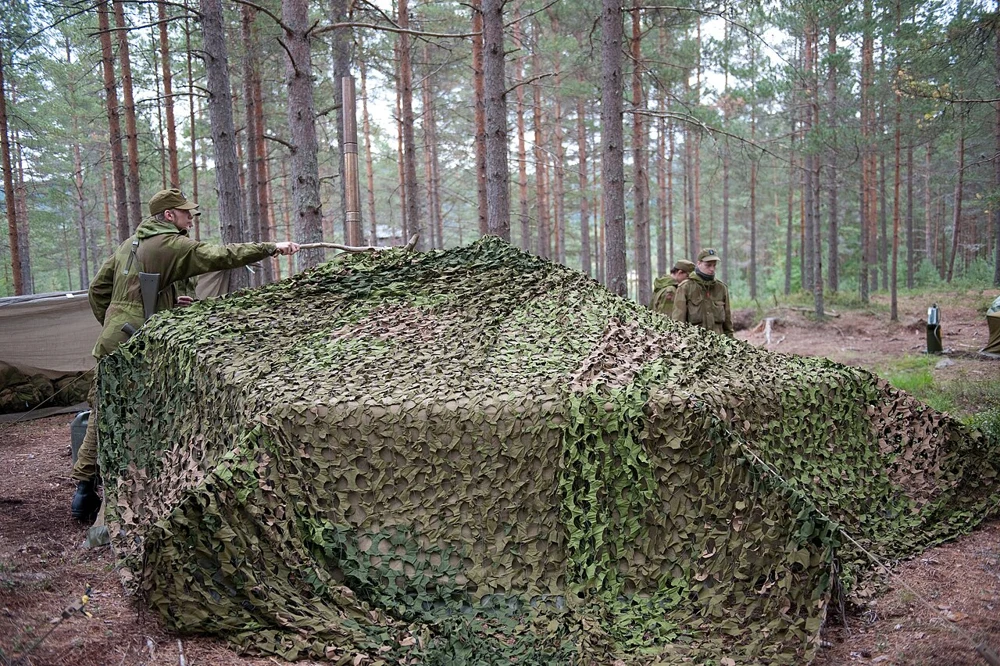
Camouflage netting during a woodland exercise at Evjemoen, Norway; photograph by Soldatnytt. Image: Soldatnytt · Source · CC BY 2.0. Commons size rendition; viewing previews may be resized.
03 / Screening and disruptive texture
Camouflage Netting — Hiding an Object’s Outline
Camouflage netting; photograph by Soldatnytt · Constructed cover in woodland
An irregular surface replaces the crisp edges of the object underneath.
Camouflage can be added to a place as well as worn by an organism. Imperial War Museums documents how camouflage teams used decorated netting and screens to conceal equipment and movement during the First World War.
Netting overlays manufactured surfaces with many small patches and uneven edges. The observer sees the cover’s texture instead of a clean object outline. Gaps, shadow and the chosen surroundings still affect how visible the covered shape is.
LOOK FOR THE DISGUISE
Look for straight lines and supports beneath the net. Then compare its irregular surface with the needles, trunks and ground around it.
The modern Norwegian photograph is an illustration of netting, separate from the historical examples in the museum source.
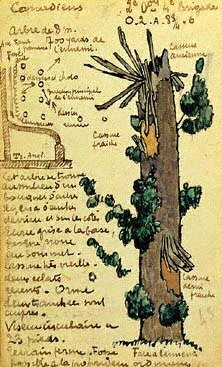
André Mare, Camouflaged Iron Observation Tree (The Elm at Vermezeele), 1916. Image: André Mare · Source · Public domain. Commons size rendition; viewing previews may be resized.
04 / Human masquerade
Camouflage Tree — An Observation Post in Disguise
André Mare; First World War camouflage designers · A constructed object imitating a tree
A manufactured observation post is made to look like an ordinary tree.
During the First World War, camouflage designers built observation posts disguised as trees. André Mare’s 1916 sketch records an iron observation tree at Vermezeele; a surviving example is held by Imperial War Museums.
This works through misidentification. The object may be visible, but its tree-like exterior encourages an observer to classify it as part of the landscape. It is a human counterpart to a leaf insect or a plant that resembles a stone.
LOOK FOR THE DISGUISE
Compare the tree-shaped exterior with the small technical drawing on the left. Look for the contrast between an apparent trunk and its constructed purpose.
This is a historical design sketch, not a photograph of a functioning observation post.
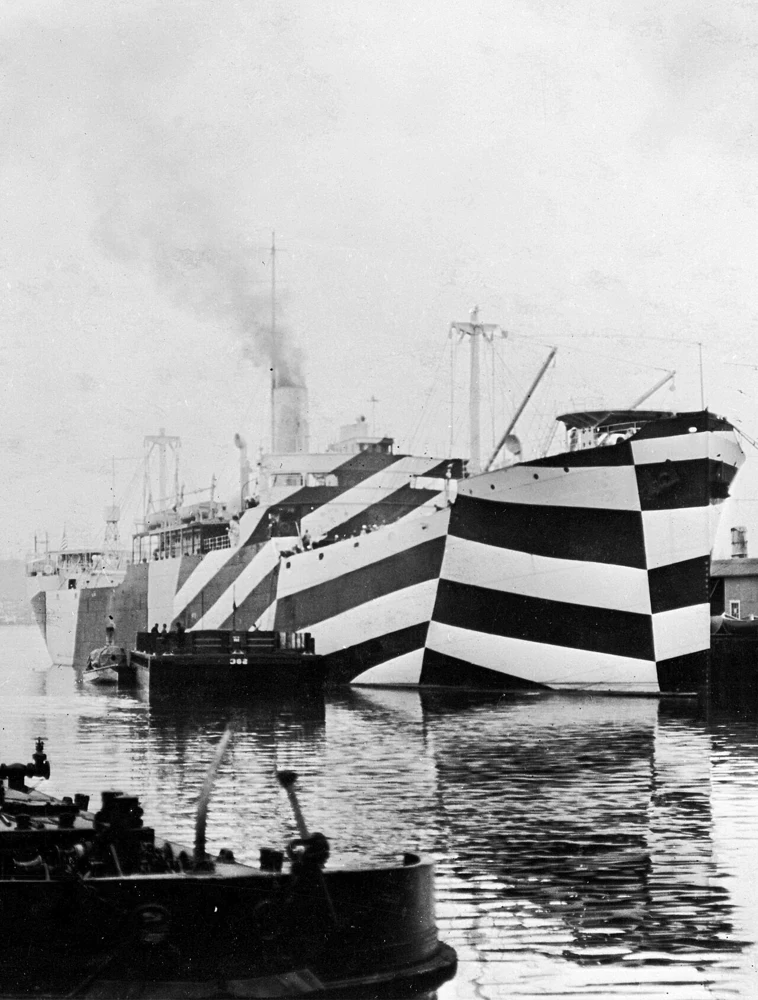
USS West Mahomet in dazzle camouflage, circa November 1918; Bureau of Ships Collection, US National Archives. Image: Photographer not identified; Bureau of Ships Collection, US National Archives · Source · Public domain. Commons size rendition; viewing previews may be resized.
05 / Dazzle and course deception
Dazzle Ships — Confusing Shape and Direction
Norman Wilkinson and naval camouflage teams · Ships at sea
Bold geometric paint changes how a ship’s shape and heading are judged.
In 1917, Norman Wilkinson proposed contrasting ship patterns intended to mislead observers about a vessel’s course. His letter to the naval authorities explains why merely painting a ship one colour could not make it disappear at sea.
Large diagonal bands interrupt the hull’s continuous form and can create misleading cues about the bow and direction of travel. Dazzle is intended to confuse interpretation even when a ship remains easy to see. Historical combat effectiveness is difficult to establish.
LOOK FOR THE DISGUISE
Look at the bow facing the camera. Try to follow the real hull edges separately from the dark painted diagonals.
Dazzle concerns perceived form and course. It differs from hiding against a background and from the separate hypothesis of motion dazzle in animals.
Ghillie suits, face paint and netting change an outline or match a background. Disguised structures encourage misidentification, while dazzle paint changes the visual cues used to judge a ship’s form and direction.
Does dazzle camouflage make a ship disappear?
Dazzle patterns are highly visible. Their purpose was to confuse judgments of a ship’s orientation and movement, rather than to make it blend into the sea.