Instructions
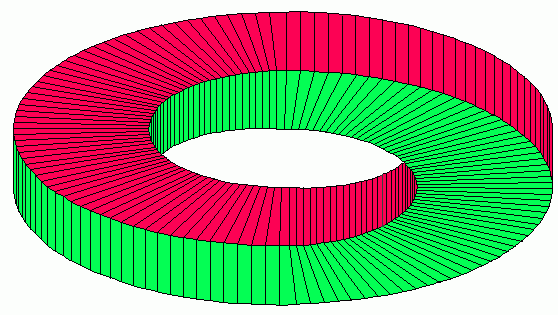
Look at the green surface: is it the front or the back surface of the ring?
Effect
You should experience a sense of perceptual confusion as you note the paradoxical nature of the depicted ring.
Illusion credit
Donald E. Simanek
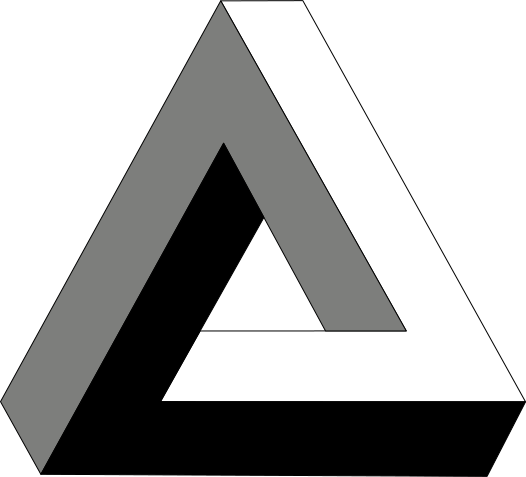
The Ambiguous Ring was designed and discussed by Donald E. Simanek (1996). Though Simanek notes that he designed the figure before seeing a resembling image as the emblem of a corporation called “Canstar” (see the figure below).The Ambiguous Ring is one of many impossible figures (or impossible objects or undecidable figures): it depicts an object which could not possibly exist. It’s impossible for the Ambiguous Ring to exist because in order for it to exist rules of Euclidean geometry would have to be violated.
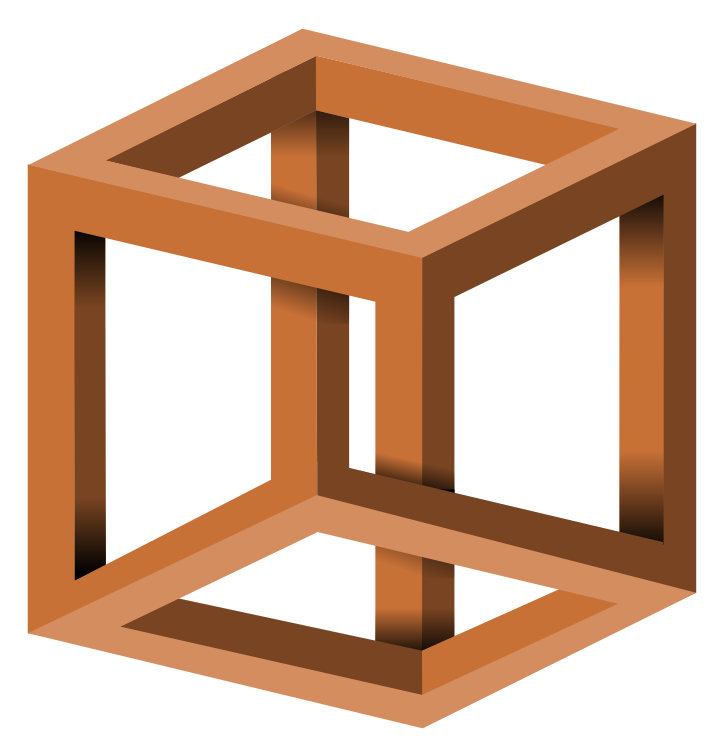
Escher and other artists such as Oscar Reutersvärd have frequently used impossible figures of varying types in their work, and mathematicians have studied the mathematical and computational properties of impossible figures to try and develop formulas and algorithms for modelling impossible objects, for use in such things as computer vision. Cognitive scientists have been interested in the processes involved in continuing to see impossible figures as possible even when we know them to be impossible. Why, for instance, do we not see the Ambiguous Ring just as some lines on a page once we realise that it can’t exist in three-dimensional space? In answering this question, debates about modularity and cognitive penetration are of central importance. To explain: on the hypothesis that the mind is modular, a mental module is a kind of semi-independent department of the mind which deals with particular types of inputs, and gives particular types of outputs, and whose inner workings are not accessible to the conscious awareness of the person – all one can get access to are the relevant outputs. So, in the case of impossible figures, a standard way of explaining why experience of the impossible figure persists even though one knows that one is experiencing an impossibility is that the module, or modules, which constitute the visual system are ‘cognitively impenetrable’ to some degree – i.e. their inner workings and outputs cannot be influenced by conscious awareness.
Philosophers have also been interested in what impossible figures can tell us about the nature of the content of experience. For example, impossible figures seem to provide examples of experiences with content that is contradictory, which some philosophers have taken to challenge the claim that perceptual states are belief-like (Macpherson 2010). They also prove problematic for sense-data accounts of perception that posit that corresponding to every experience that we have there are mental objects that we are aware of that have the properties that the objects that our experiences tell us they do. They problem is that sense-data would have to be impossible objects. But surely, impossible objects can't exist!
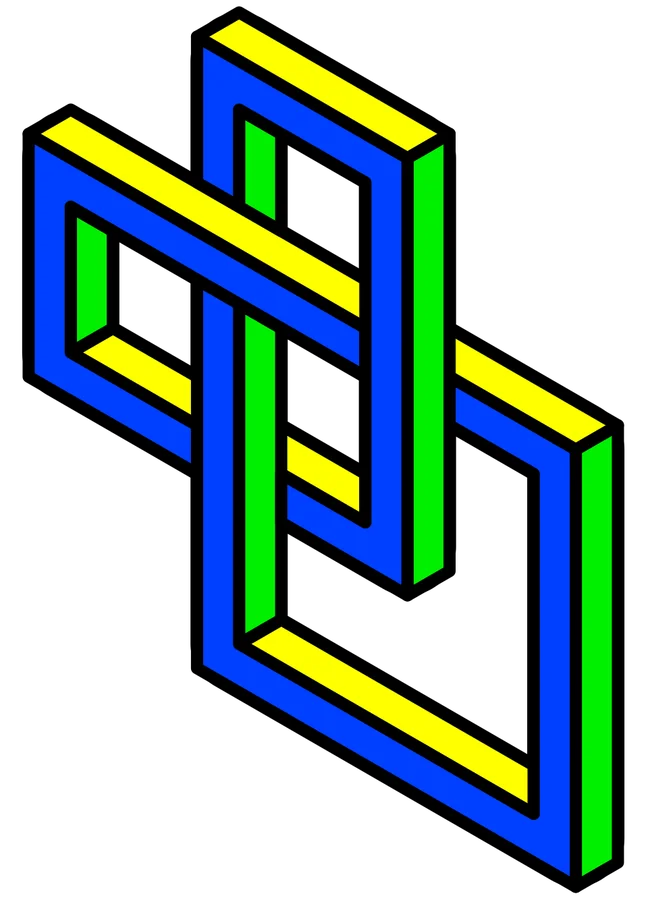
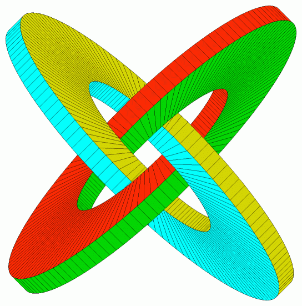
For an interesting variation on the Ambiguous Ring, see the Impossibly linked ambiguous rings, which is designed by Donald Simanek in 2004:Please note that the ambiguous ring is not the same as the Möbius strip (or Möbius band) depicted below. The Möbius strip is a perfectly possible object that one can make by taking a strip of paper, laying it flat, then giving it a twist and joining the ends together. It is an object that ends up have only one surface and only one side (at least when it exists within a Euclidean geometrical framework). It was discovered independently by August Ferdinand Möbius and Johan Benedict Listing, both German mathematicians in 1858.
References
Macpherson, F. 2010. Impossible Figures. In Goldstein, E. B. ed., Sage Encyclopedia of Perception. Sage Publications, Inc.
Escher, M. C. 1958. Belvedere. Ontario: National Gallery of Canada. Print.
Simanek, D. E. (1996) “Visual Illusions: The Principles of Artistic Illusions”, downloaded from https://dsimanek.vialattea.net/3d/illus1.htm, 28th August 2017
Article links
Additional images & credits
Images and audio are stored on this website. Source media credits and license labels are reproduced as supplied; an author credit alone does not grant a reuse license.
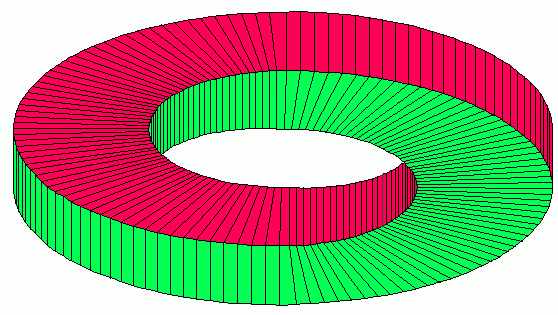
An animated red-and-green ring with striped surfaces whose apparent depth can reverse.
The shape of this ring is impossible - it is impossible to create a 3D object that would have the features of the depicted ring.
Source license / credit label: Donald E. Simanek.
Source credit: https://dsimanek.vialattea.net/3d/illus1.htm.

The Canstar logo: a black-and-white ring whose front and back can be interpreted in different ways.
Source license / credit label: Not specified for this media item.
Source credit: Donald E. Simanek.
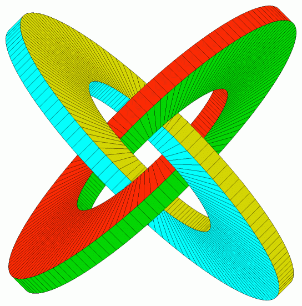
Three coloured, intersecting rings in an animation of ambiguous depth and surface connections.
Source license / credit label: Not specified for this media item.
Source credit: Donald E. Simanek.
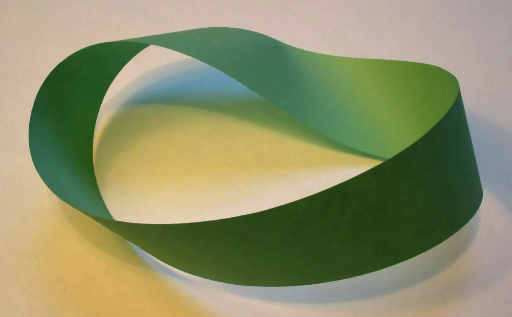
A green paper strip joined into a loop with a half twist to form a Möbius strip.
Photograph of a Möbius strip by David Benbennick (2005). Copyright CC BY-SA 3.0
Source license / credit label: Not specified for this media item.
Source credit: Donald E. Simanek.