Instructions
Look at the strawberries in the image. What colour are they?
Effect
You should have the experience of red strawberries in the picture, but the picture doesn't contain any red colour.
Illusion credit
Akiyoshi Kitaoka, Professor of Psychology at Ritsumeikan University
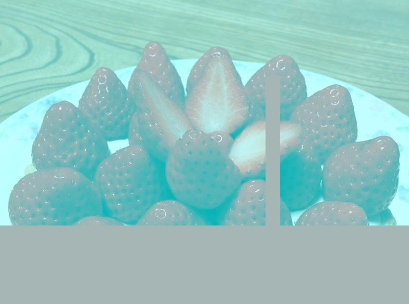
This image was created by Akiyoshi Kitaoka and went viral on the internet when Kitaoka shared it on Twitter. Although the image contains no red pixels, one cannot help but see the strawberries as red. That they are in fact grey can be seen in a number of ways. You could occlude the rest of the picture and look at only one apparently red part of a strawberry and compare it with a grey image. Alternatively, you can have a look at the figure below, created by Tim Hutton (also shared on Twitter in February 2017) that has a grey strip along the bottom and a grey strip coming up from that into the picture of the strawberries. (However, some people experience the strawberries as so red that the grey strip at the bottom ends up looking red to them!)
The mechanism that is (at least in part) responsible for this illusion is colour constancy. Colour constancy is a process that allows people to perceive the colour of something under very different illumination/lighting conditions. (See Troost (1998), Hurlbert (1998), Neumeyer (1998) and Komatsu (1998) for discussion of colour constancy). The mechanism that is responsible for colour constancy normally works in our favour. What colour we experience an object to be is partly determined by the surface of the object and the light it reflects, but also the lighting conditions (e.g. bright sunlight or shade), and the colours of the object surrounding it. Our brain works out the colours of objects partly by comparing them to the colours of objects around them. It is this mechanism that allows us to experience a green shirt as green under lots of different lighting conditions (e.g. in normal daylight, under fluorescent streetlighting, and during sunset). This is partially what makes object-tracking possible in tricky lighting conditions. But in this clever example, this system works against us. The colour distribution in the overall picture makes our brain cause us to have an experience of the strawberries as being red.
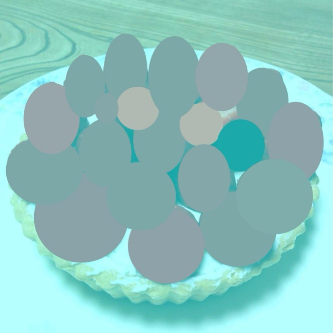
It might be tempting to think that what is happening here is an instance of what is known as the cognitive penetrability of perceptual experience, namely the idea that our beliefs may influence our perceptual experiences. For an examination of the general issue of cognitive penetration, see Macpherson (2012). Inspired by Hansen et. al. (2006), one might think that what is happening here is that our knowledge that strawberries are normally red influences our visual experience of these grey strawberries, priming us to experience them as red. However, further reflection on this case reveals that what is going on here is not cognitive penetration. As Michael Bach shows with the help of the figure below, the illusory appearance of redness persists even when the objects depicted in the picture don’t look like strawberries.
Other examples of illusory colour experiences due to colour constancy include the image below, also created by Akiyoshi Kitaoka. Although there is no red pixel in the picture below, one experiences the letter “R” in the left-hand side and the background of “R” on the right-hand side as red.
A philosophically interesting dimension of this illusion has to do with the question of what is the direct object of our visual experiences. Direct realists think that when we perceive the world accurately, the immediate objects of visual experiences are physical objects that we look at and their properties. This view is challenged by the existence of illusions—such as the grey strawberry illusion in which we misperceive greyness as redness. The challenge is that we seem to be aware of redness when there is no redness in the world in front of us. So, illusions have led some philosophers to become sense-data theorists. They hold that the direct objects of visual experiences are not physical objects, but mental objects called ‘sense-data’. They will argue that in the grey strawberry illusion one is immediately aware of redness, despite there being no red physical object (or texture on the computer screen). Direct realists can reply to this challenge in numerous ways. They might claim that we are not aware of redness when we experience the illusion and only think that we are. We are really aware of the greyness of the image, but we just don't take ourselves to be so. For philosophical discussion about the objects of experience, see Crane & French (2016).
References
Crane, T., and French, C., 2016. The Problem of Perception. In: Zalta, E. N., ed. The Stanford Encyclopedia of Philosophy. Metaphysics Research Lab, CSLI, Stanford University.
Gilchrist, A. L., 2010, ‘Lightness Constancy’, in Goldstein, E. B. (Ed), Sage Encyclopedia of Perception, Sage Publications, Inc: London.
Hansen T, Olkkonen M, Walter S & Gegenfurtner KR. 2006. Memory modulates color appearance. Nat Neurosci, 9(11):1367-8.
Hurlbert, A. C. 1998. ‘Computational models of color constancy’, in V. Walsch & J. Kulikowski (Ed.), Perceptual constancy: why things look as they do. Cambridge: Cambridge University Press.
Komatsu, H. 1998. ‘The physiological substrates of color constancy’, in V. Walsch & J. Kulikowski (Ed.), Perceptual constancy: why things look as they do. Cambridge: Cambridge University Press.
Macpherson, F., 2012. Cognitive penetration of colour experience: Rethinking the issue in light of an indirect mechanism. Philosophy and Phenomenological Research, 84(1), pp.24-62.
Neumeyer, C. 1998. ‘Comparative aspect of color constancy’, in V. Walsch & J. Kulikowski (Ed.), Perceptual constancy: why things look as they do. Cambridge: Cambridge University Press.
Troost, J. M. 1998. ‘Empirical studies in color constancy’, in V. Walsch & J. Kulikowski (Ed.), Perceptual constancy: why things look as they do. Cambridge: Cambridge University Press.
https://twitter.com/_tim_hutton_/status/836611814096060416/photo/1?ref_src=twsrc%5Etfw&ref_url=http%3A%2F%2Fwww.bbc.co.uk%2Fnewsbeat%2Farticle%2F39132378%2Fthese-strawberries-are-red-right-wrong
https://twitter.com/AkiyoshiKitaoka/status/836382313160171521
http://www.michaelbach.de/ot/col-strawbsNotRed/index.html
https://pbs.twimg.com/media/C5uoTwUVAAAmtt4.jpg
Article links
- shared it on Twitter ↗
- https://twitter.com/_tim_hutton_/status/836611814096060416/photo/1?ref_src=twsrc%5Etfw&ref_url=http%3A%2F%2Fwww.bbc.co.uk%2Fnewsbeat%2Farticle%2F39132378%2Fthese-strawberries-are-red-right-wrong ↗
- https://twitter.com/AkiyoshiKitaoka/status/836382313160171521 ↗
- http://www.michaelbach.de/ot/col-strawbsNotRed/index.html ↗
- https://pbs.twimg.com/media/C5uoTwUVAAAmtt4.jpg ↗
Additional images & credits
Images and audio are stored on this website. Source media credits and license labels are reproduced as supplied; an author credit alone does not grant a reuse license.
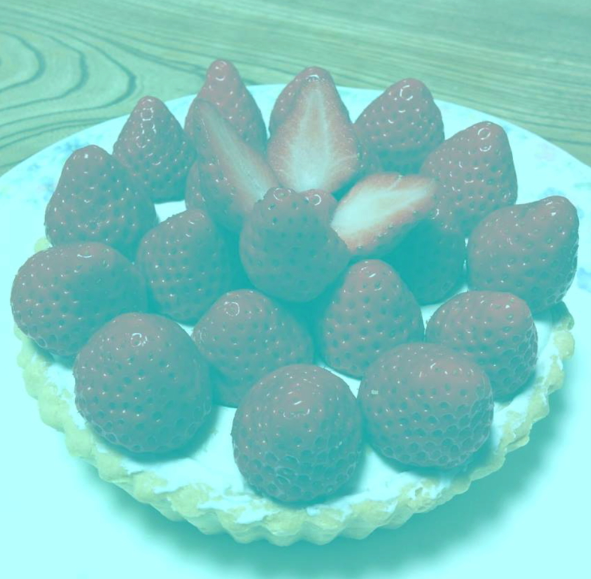
A photograph of strawberries on a plate under a cyan tint, used to demonstrate colour constancy.
A bowl of strawberries that look red but are not.
Source license / credit label: Akiyoshi Kitaoka.
Source credit: https://twitter.com/AkiyoshiKitaoka/status/836382313160171521.
The cyan-tinted strawberry photograph with a grey comparison area and sampling marker.
Source license / credit label: Not specified for this media item.
Source credit: Akiyoshi Kitaoka, Professor of Psychology at Ritsumeikan University.
Grey patches cover parts of the cyan-tinted strawberry photograph to reveal the underlying image colours.
Image from http://www.michaelbach.de/ot/col-strawbsNotRed/index.html
Source license / credit label: Not specified for this media item.
Source credit: Akiyoshi Kitaoka, Professor of Psychology at Ritsumeikan University.

Two signs bearing the letter R photographed against foliage, with contrasting colour casts.
Image from https://pbs.twimg.com/media/C5uoTwUVAAAmtt4.jpg
Source license / credit label: Not specified for this media item.
Source credit: Akiyoshi Kitaoka, Professor of Psychology at Ritsumeikan University.