Instructions
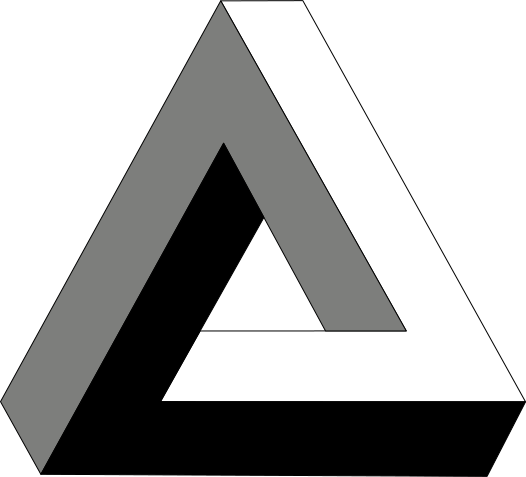
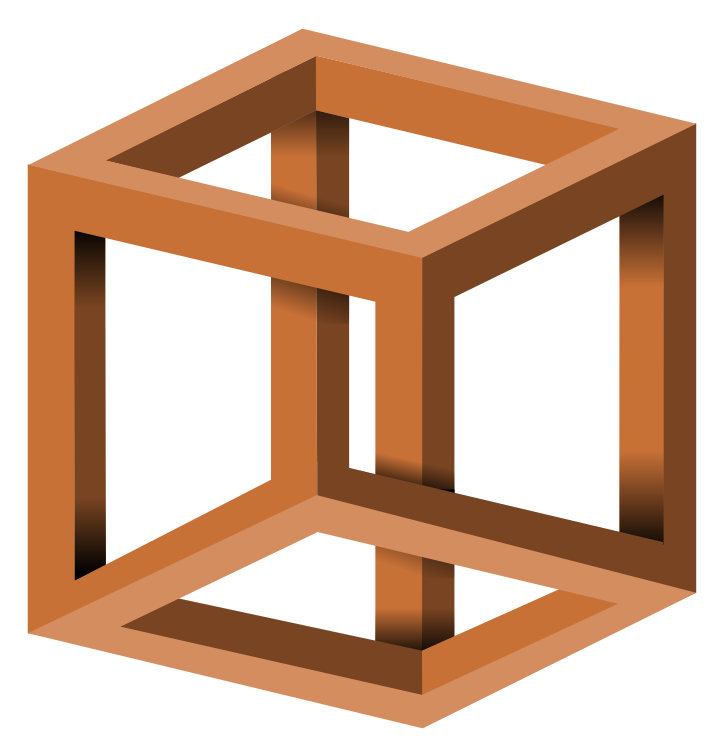
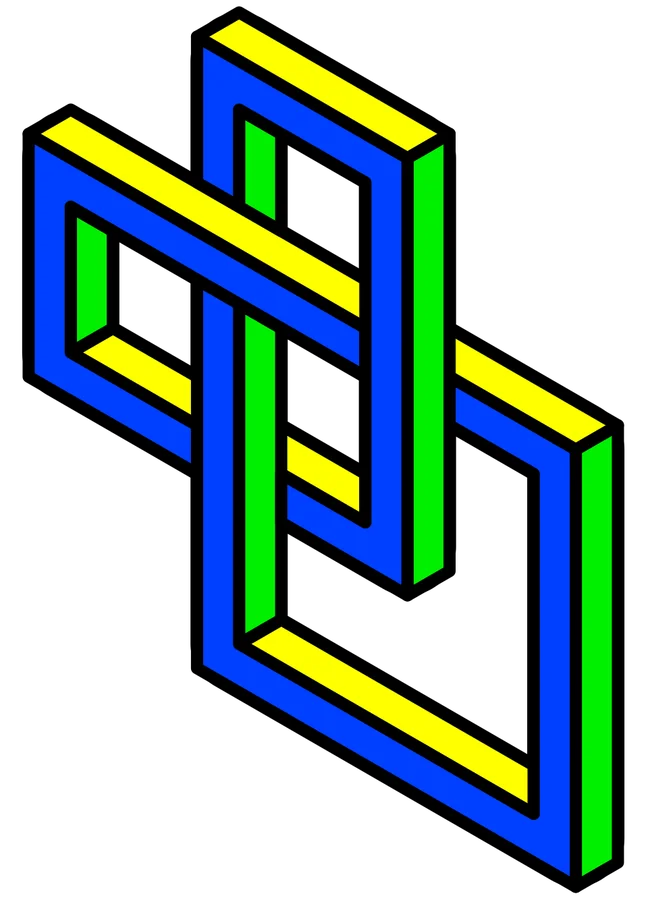
Look at any of the corners in the image. Try to connect these corners to each other. Consider whether it would be possible to create a 3D object with these corners.
Effect
You should experience a sense of perceptual confusion as you note the paradoxical nature of the corners.
Illusion credit
Oscar Reutersvärd (1915 - 2002), Swedish graphic artist
The Impossible Corners figure belongs to a group of illusory figures that are known as ‘impossible figures’. The Impossible Corners figures were designed by Swedish graphic artist Oscar Reutersvärd (1915 – 2002).
Although when we are looking at the Impossible Corners figures, what we see is some two-dimensional lines and colours on the surface, we are immediately disposed to take the image to depict a three-dimensional object, which could possibly exist in the physical world. However, further reflection reveals that the image depicts an impossible object (an object which simply couldn’t, even in principle, exist in physical reality). So, these figures do not only depict something that does not exist as a matter of fact (for example a unicorn); they depict things that could not possibly exist (such as a round-square).
One question, interesting from a psychological perspective is this: Why are we primed to perceive Impossible Corners as predicting a three-dimensional object, despite knowing that such an object would be physically/geometrically impossible? One answer is that our visual system, to some degree, can work independently of our beliefs. This has implications regarding the modularity of the mind. On the hypothesis that the mind is modular, a mental module is a kind of semi-independent department of the mind which deals with particular types of inputs, and gives particular types of outputs, and whose inner workings are not accessible to the conscious awareness of the person – all one can get access to are the relevant outputs. For example, even though one knows that, with the Impossible Corners illusion, the depicted corner is impossible, it still appears as if it could exist; the modules that make up the relevant parts of the visual system continue to output the possible appearance, despite one’s conscious awareness that this is incorrect. Although the details and the implications of the modularity of the mind are widely debated, that there are modules in some sense or other is now widely accepted (see Fodor 1983 for the classic statement of the argument for modularity).
This still doesn’t answer how it is that the visual system tries to depict these figures as three-dimensional objects. One answer is that when looking at these figures, the visual system applies the law of proximity, which suggests that if there is no visible gap between two elements in a picture, then they are perceived as forming one object. For example, in the Impossible Corners figure, the visual system is trying to connect all the corners, as if it would be possible to start from one corner, visit all others in a row, and finish at the same corner. But put in a three-dimensional space, we know that this can’t be done.
An interesting philosophical question is why we can still depict Impossible Corners, whereas we can’t depict some other impossible objects. For example, a round-square is an impossible object too: no object can be both round and square! Try to imagine such an object. Why do you fail to do so, despite our success in depicting other impossible figures such as Impossible Corners? One answer is that objects depicted by impossible figures (such as Impossible Corners) can be divided into parts all of which are physically and geometrically possible objects, whereas this cannot be done with a round-square; a round-square doesn’t have any parts that is possible. For further discussion, see Macpherson (2010), Ernst (1986), Penrose & Penrose (1958), Young & Deregowski (1981), and Kulpa (1987).
References
Ernst, B. (1986). Adventures with Impossible Figures. Norfolk: Tarquin.
Macpherson, F. (2010.) Impossible Figures. Sage Encylopedia of Perception (edited by E.B. Goldstein), Thousand Oaks, CA: Sage Publications.
Fodor, J.A., 1983. The modularity of mind: An essay on faculty psychology. MIT press.
Penrose, L. S. and Penrose, R. (1958). Impossible objects: A special type of illusion. British Journal of Psychology, 49, 31-33.
Young, A. W. and Deregowski, J. B. (1981). Learning to see the impossible. Perception, 10, 91-105.
Kulpa, Z. (1987). Putting order in the impossible. Perception, 16, 201-214.
Article links
Additional images & credits
Images and audio are stored on this website. Source media credits and license labels are reproduced as supplied; an author credit alone does not grant a reuse license.
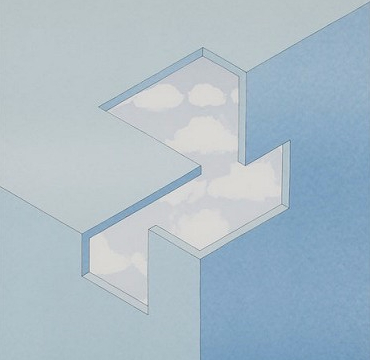
A pale blue drawing of connected corners whose locally plausible edges cannot form a consistent solid.
The corners of the object depicted are impossible - it is impossible to create a 3D object that would have the features depicted
Source license / credit label: Oscar Reutersvärd.
Source credit: http://im-possible.info/english/art/reutersvard/corners01.html#.
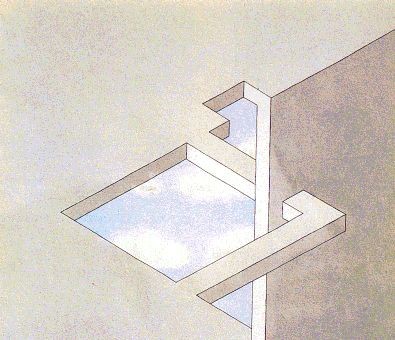
A pastel drawing of an open architectural frame with incompatible corner connections.
The corners of the object depicted are impossible - it is impossible to create a 3D object that would have the features depicted
Source license / credit label: Oscar Reutersvärd.
Source credit: http://im-possible.info/english/art/reutersvard/corners01.html#.
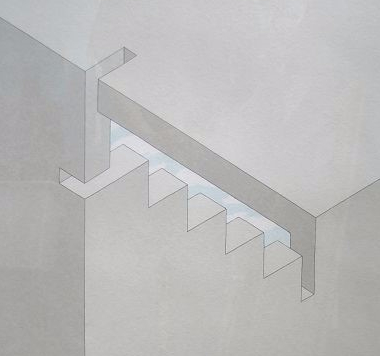
A grey drawing of a stairway and wall joined through an impossible corner arrangement.
The corners of the object depicted are impossible - it is impossible to create a 3D object that would have the features depicted
Source license / credit label: Oscar Reutersvärd.
Source credit: http://im-possible.info/english/art/reutersvard/corners01.html#.