Instructions
Watch the video below with the sound on. Each time a disk appears, how many times does it seem to flash?
Effect
The disk always flashes once. Sometimes it is accompanied by one beep, and then people report one flash. However, when it is accompanied by two beeps some people report experiencing two flashes.
Illusion credit
Ladan Shams, Yukiyasu Kamitani, and Shinsuke Shimojo
Video downloaded from:
Video demonstration in the player above.
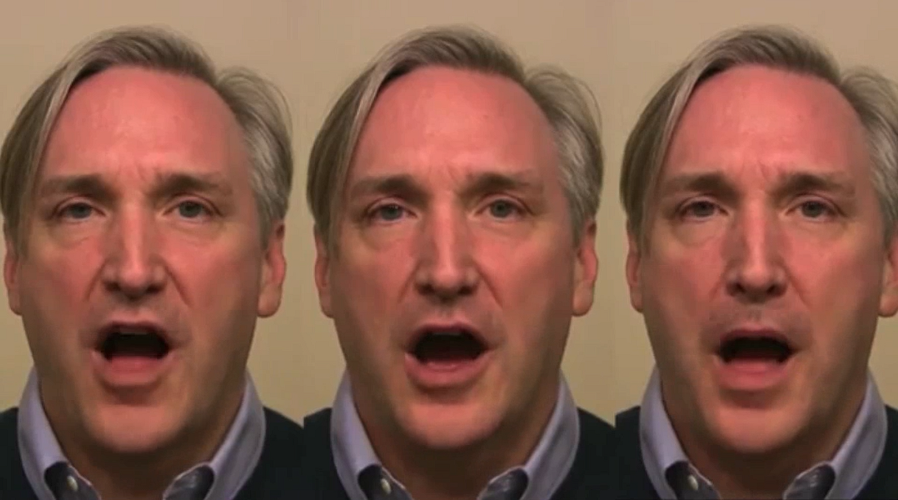
The Sound-Induced Flash illusion is a cross-modal effect. This is an effect in which what is processed or experienced in one sensory modality affect what is processed or experienced in another. In the Sound-Induced Flash illusion, what you visually experience is affected by what you hear. The illusion was discovered and studied by Ladan Shams and colleagues (Shams et al. 2000). As can be seen in the video above, although the same number of dots flashes on the screen when one and two beeps are sounded, when there are two beeps, people frequently report experiencing two flashes. Shams and colleagues hypothesise that the “alteration of the visual percept is due to cross-modal perceptual interactions as opposed to cognitive, attentional, or other origins” (Shams et al. 2002). You can search for other cross-modal illusions in the Illusions Index.
The Sound-Induced Flash illusion is philosophically interesting because it highlights the difficulties surrounding the question of how to individuate the sensory modalities. The traditional view, attributed to Aristotle, and taught to pretty much every schoolchild in early years of education, is that humans have five senses: sight, hearing, smell, touch and taste. The traditional view has often been accompanied by the view that these senses work separately and can be studied in isolation, as they process distinct types of sensory information. Both of these views are now largely overturned. See Macpherson (2011a) for a philosophical discussion of what sensory modalities there are and how they can be individuated or distinguished from one another, although alternative perspectives are given in Nudds (2004) and Richardson (2013). The existence (and abundance) of cross-modal illusions and cross-modal effects on perceptual experience puts pressure on the view that the senses work separately and can be studied in isolation. Much work has been carried out on this topic is psychology. See for instance, Stein (2012). Likewise, philosophers are also considering what this means for thinking about the types of experience that there can be. See, for example, Macpherson (2011b) and Richardson (2014).
It is interesting to consider whether the Sound-Induced Flash illusion should be classified as an illusion. Philosophers of perception typically make a distinction between two types of non-veridical experiences: illusions and hallucinations. In cases of illusion, we are aware of real, physical, objects around us, but we fail to perceive one or more of their properties accurately. In cases of hallucination however, it is typically thought that we have experiences of objects that are not there in physical reality. (However, an alternative to this conception of illusion and hallucination is given in Macpherson and Batty (2016).) In the Sound-Induced Flash illusion when there is only one flash on the screen (accompanied by two beeps) yet we experience two flashes, it might be argued that this is a case of hallucination: one hallucinates a second flash, which is not there in reality.
However, there is some reason to resist this explanation and to think of the case as one of illusion, for what is going on bears an interesting similarity to cases of double vision, in which one has a visual experience as of two objects when only one is present. (For example, hold your index finger up very close and in between your eyes and you will experience two index fingers, when in fact there is just one present.) Philosopher E. J. Lowe (2000, p.109) claims that this phenomenon is best thought of as perceiving the finger twice—once with each eye— that results in two experiences of a finger. At least one of the experiences of the finger, but likely both, will then be illusory with respect to the location of the finger. Transferring this line of thought to the Sound-Induced Flash illusion, one would say that one sees the disk twice—at different times—and this results in two experiences of the disk, at least one of which is illusory with respect to the time of its occurrence.
References
Lowe, E. J. (2000). An Introduction to the Philosophy of Mind. Cambridge: Cambridge University Press
Macpherson, F. (2011a). Individuating the Senses. In Macpherson (ed.) The Senses: Classical and Contemporary Readings, Oxford University Press
Macpherson, F. (2011b) "Cross-Modal Experiences", Proceedings of the Aristotelian Society, 111(3): 429-468
Macpherson, F. and Batty, C. (2016) "Redefining Illusion and Hallucination in Light of New Cases", Philosophical Issues, 26: 263 - 296.
Nudds, M. (2004) "The Significance of the Senses", The Proceedings of the Aristotelian Society, 104 pp. 31-51
Richardson, L. (2013) "Flavour, Taste and Smell", Mind and Language, 28: 322–341
Richardson, L. (2014) “Non Sense-Specific Perception and the Distinction Between the Senses’, Res Philosophica, 91 (2): 215 - 239
Shams L., Kamitani Y., Shimojo S. (2000). What you see is what you hear. Nature 408, 788–788 10.1038/35048669
Shams L., Kamitani Y., Shimojo S. (2002). A visual illusion induced by sound. Cogn. Brain Res. 14, 147–152
Stein, B. E. (2012) The New Handbook of Multisensory Processing, Cambridge MA: MIT Press
Additional images & credits
Images and audio are stored on this website. Source media credits and license labels are reproduced as supplied; an author credit alone does not grant a reuse license.

A single black circular flash marker on a white field for a sound-induced flash demonstration.
Sound-Flash Effect is a cross-modal illusion in which what you experience visually is affected by what you hear. It is the result of asynchronous visual and auditory stimuli.
Source license / credit label: Not specified for this media item.
Source credit: Ladan Shams, Yukiyasu Kamitani, and Shinsuke Shimojo.
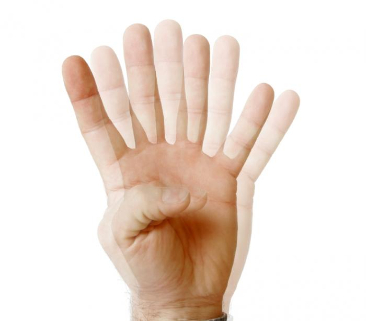
A composite image of a hand with overlapping finger positions, used as another sensory illustration.
Source license / credit label: Not specified for this media item.
Source credit: Ladan Shams, Yukiyasu Kamitani, and Shinsuke Shimojo.