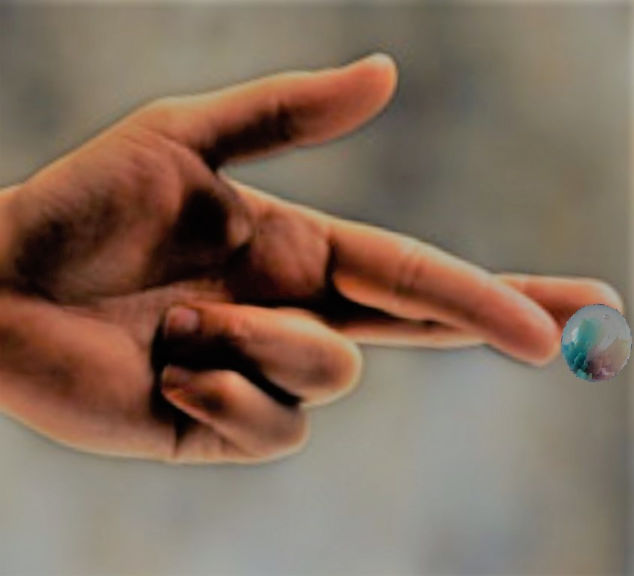
Instructions
Press the palm of your hand and fingers against the curved inside or outside of a salad bowl or a basketball for about half a minute. Then press them on a flat surface. Close your eyes for a stronger effect.
Effect
When you press your hands to the flat surface you should experience the flat surface as curved for a few seconds.
Illusion credit
I.M. Vogels Vogels, A. M., Kappers and J.J. Koenderink J. J. (1996)
This illusion was demonstrated by Vogels (1996) and colleagues in experiments in which subjects were first asked to press their hands on a curved surface for a fixed conditioning period, then move their hands to a flat surface, and judge the shape of the second surface. The experiments showed that we are more likely to judge a flat surface to be convex if our hands were previously exposed to a concave surface (and vice versa).
This tactile aftereffect illusion bears interesting similarities to other aftereffect illusions in other sensory modalities. For example, aftereffects can be observed in vision (examples of which can be found in the Illusions Index). The well-known Waterfall Illusion is a good example of a visual motion aftereffect. Once your eyes are exposed to continuous motion in one direction, when you move your eyes to a stationary scene, you experience an illusory motion in the direction that is opposite of the motion you experience in the conditioning period. This is similar to the tactile aftereffect illusion in which the illusory shape you experience has the opposite feature to the shape that you were experiencing in the conditioning: convex and concave (Hayward 2007).
Typically, philosophical discussions of illusory and hallucinatory experiences focus on visual ones. But tactile illusions and hallucinations (and ones in other sensory modalities such as audition, taste, smell, and so on, including cross-modal ones) are also interesting. Illusions and hallucinations in general provide us with cases in which what we experience doesn't seem to match reality. If that's right, we are not experiencing reality, and we can ask what it is that we are experiencing. If that's not right, then we can ask why we appear to experience something that doesn't match reality, and whether we really are experiencing what we take ourselves to be experiencing. Illusions and hallucinations in sensory modalities other than vision show us that this issue affects experiences in other modalities.
References
Hayward, V. (2007). “A brief taxonomy of tactile illusions and demonstrations that can be done in a hardware store.” Brain research bulletin 75(6): 742-752.
Vogels I. M., Kappers A. M., and Koenderink J. J. (1996). “Haptic aftereffect of curved surfaces.” Perception 25(1): 109-19.
Article links
Additional images & credits
Images and audio are stored on this website. Source media credits and license labels are reproduced as supplied; an author credit alone does not grant a reuse license.
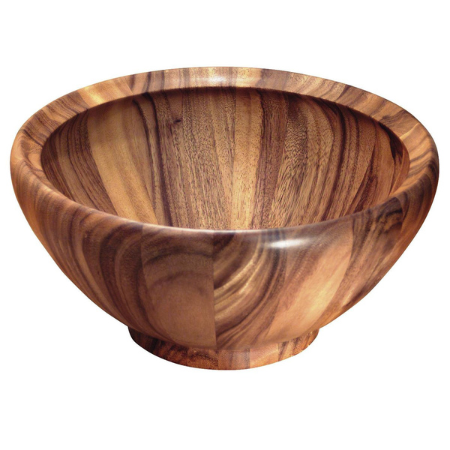
A wooden bowl on white illustrating the tactile aftereffect article.
Tactile aftereffect happens when your hands get used to the feel of an object, and touch something else. You can create this small experiment at home!
Source license / credit label: AliExpress.
Source credit: http://bit.ly/2xk2a60.