Instructions
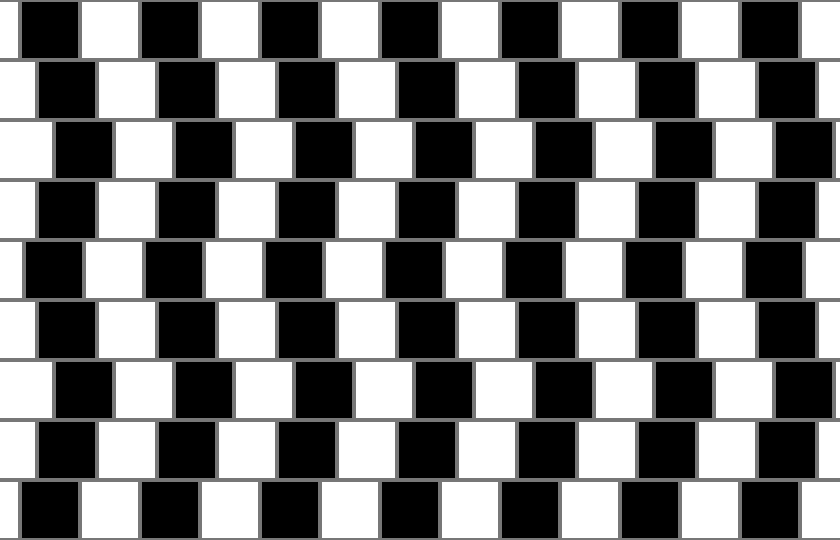
This illusion consists of a checkerboard-like arrangement, in which individual rows have been displaced. Look at the grey horizontal lines between the rows of the board. Are they parallel to one another?
Effect
The horizontal grey lines appear to be angled with respect to one another - in fact they are all parallel.
Café Wall Illusion
The Café Wall illusion was noticed as a pattern in the brickwork of a café on St Michael’s Hill in Bristol, by British psychologist Richard Gregory CBE FRS FRSE (1923-2010). In fact, this was a rediscovery – the same illusory effect was studied much earlier as one of a number of visual illusions involving chessboard-like figures (see Pierce 1898).
A modern powerful version of the illusion has been created by Victoria Skye (www.victoriaskye.com) who has given us permission to use it here.The precise cause of the illusion is not well understood, although it appears to involve interactions between the neurons in the visual cortex which code for orientation. It is unclear whether some inhibitory mechanism is at play, or if there is a kind of computational filter acting on input from cells operating at different spatial frequencies, i.e. taking their inputs from larger or smaller areas of the visual field (Takeuchi 2005).
This illusion is interesting because it is relevant to debates about modularity, cognitive penetration, and the nature of experience. To explain: on the hypothesis that the mind is modular, a mental module is a kind of semi-independent department of the mind which deals with particular types of inputs, and gives particular types of outputs, and whose inner workings are not accessible to the conscious awareness of the person – all one can get access to are the relevant outputs. So, in the case of the Café Wall Illusion, a standard way of explaining why experience of the illusion persists even though one knows that one is experiencing an illusion is that the module, or modules, which constitute the visual system are ‘cognitively impenetrable’ to some degree – i.e. their inner workings and outputs cannot be influenced by conscious awareness. For a general discussion of cognitive penetration, see Macpherson (2012).
Philosophers have also been interested in what illusions like this illusion can tell us about the nature of experience. For example, in the case of experiencing the Café Wall Illusion, it would seem to be that the one can know that the lines are parallel whilst at the same time one experiences them as unparallel. If so, then this might count against the claim the perceptual states are belief-like, because if perceptual states were belief like then, when experiencing the Café Wall Illusion, one would simultaneously believe that the lines were, and were not, parallel. This would seem to entail that one was being irrational, because one would simultaneously be holding contradictory beliefs. But it seems highly implausible that one is being irrational when undergoing this illusion. For discussion of this general point about whether perceptions are like beliefs, see Crane & French (2016).
References
Crane, T., and French, C., 2016. The Problem of Perception. In: Zalta, E. N., ed. The Stanford Encyclopedia of Philosophy. Metaphysics Research Lab, CSLI, Stanford University.
Gregory, R.L. and P. Heard, 1979. ‘Border locking and the Café Wall illusion’, Perception Vol 8 (4) pp. 365-380.
Macpherson, F., 2012. Cognitive penetration of colour experience: Rethinking the issue in light of an indirect mechanism. Philosophy and Phenomenological Research, 84(1), pp.24-62.
Pierce, A. H., 1898. ‘The illusions of the kindergarten patters’, Psychological Review Vol 5 (3) pp.233-253.
Takeuchi, T., 2005. ‘The effect of eccentricity and the adapting level on the café wall illusion’, Perception and Psychophysics Vol 67 (7) pp. 1113-1137.
Images
Photograph of Richard L Gregory, Feb 2010. Attributed to Steven Battle and reproduced under CC By-SA 3.0 https://creativecommons.org/licenses/by-sa/3.0/, https://commons.wikimedia.org/wiki/File:CafeWall.jpg
Article links
- www.victoriaskye.com ↗
- https://creativecommons.org/licenses/by-sa/3.0/ ↗
- https://commons.wikimedia.org/wiki/File:CafeWall.jpg ↗
Media & demonstrations
Open source links to use interactive demonstrations and embedded recordings. Source media credits and license labels are reproduced as supplied.
Café-Wall Illusion as of non-parallel lines ↗
Source license label: Share-alike.
Source credit: http://creativecommons.org/licenses/by-sa/3.0/
Source license label: Not specified for this media item.
Source license label: Not specified for this media item.