A surface with one side. A solid that hides a cube. A bottle with no inside. These objects challenge our everyday ideas about shape, space, and boundaries.
Some can be made with paper or solid materials; others need extra dimensions to exist without crossings. Each follows a precise mathematical rule.
One half twist changes how the entire surface connects.
01 / One-sided surface
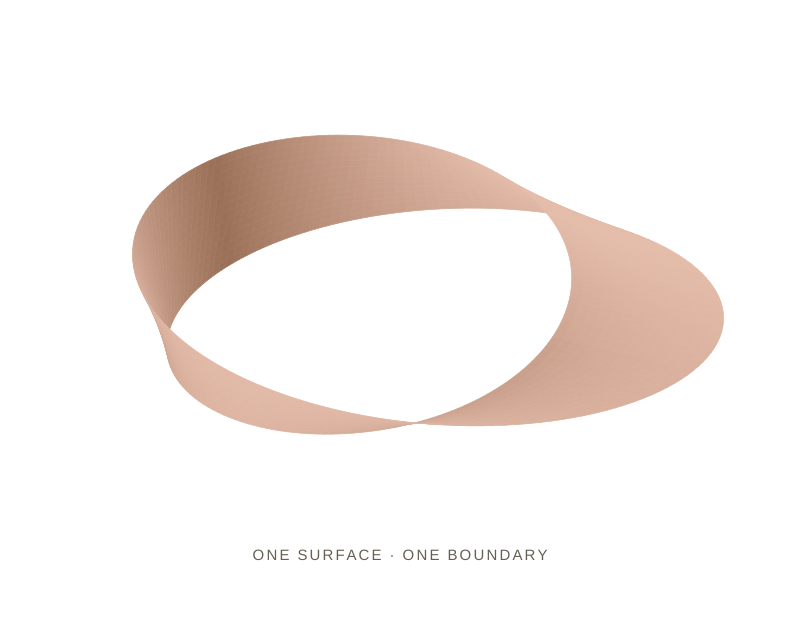
Möbius strip
Follow the surface and you reach what looked like the other side, without crossing an edge.
Join the ends of a strip after giving it a half turn. The result has one continuous side and one continuous boundary. A tiny traveller on the surface can go around the loop and return with its orientation reversed. Mathematicians call this non-orientability.
Can it exist? Yes, in ordinary three-dimensional space. A paper model approximates the mathematical surface, which has no thickness.
A WAY TO UNDERSTAND IT
Make a paper loop with a half twist. Draw a line along its centre until you return to the start. Then trace the edge: both apparent edges belong to one continuous boundary. Cut along the centre line to get one longer loop with two full twists, rather than two separate loops.
Independently studied by August Ferdinand Möbius and Johann Benedict Listing in 1858.
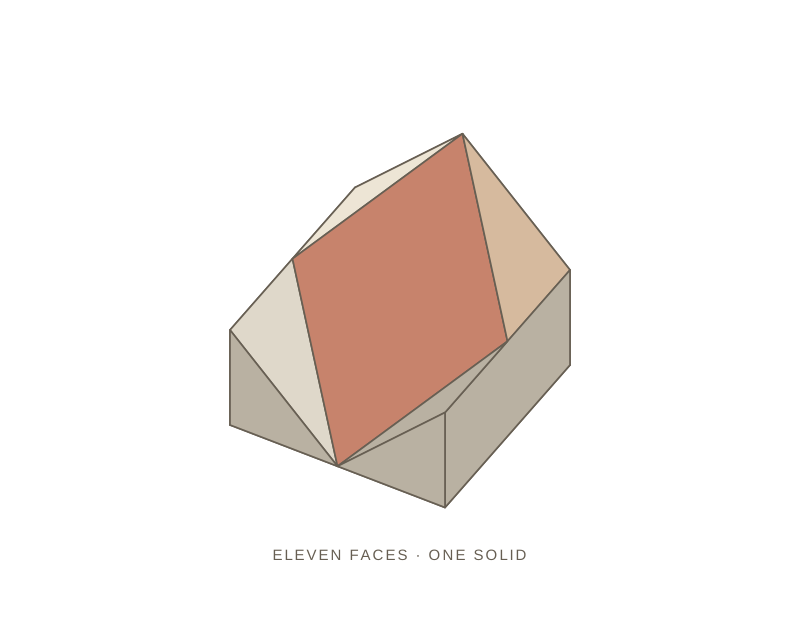
A sloping diamond and triangular facets above a square base.
02 / Eleven-faced solid
K-dron
An unfamiliar solid whose partner completes a familiar cube.
The K-dron is a polyhedron with eleven faces, a square base, and a diamond-shaped face inclined at 45 degrees. Its surface combines hollows and peaks. Two complementary K-drons fit together to form a cube. Repeated arrangements create patterns whose light and dark regions change with illumination.
Can it exist? Yes. It is a solid that can be built, cast, or used as a tile; its surprise comes from how its facets fit together.
A WAY TO UNDERSTAND IT
Find the diamond-shaped face in the illustration, then imagine a second piece filling the space above the facets to complete a cube. Follow the creator’s animations below to see the two pieces join and separate.
Discovered by artist and designer Janusz Kapusta in 1985; patented in 1987.
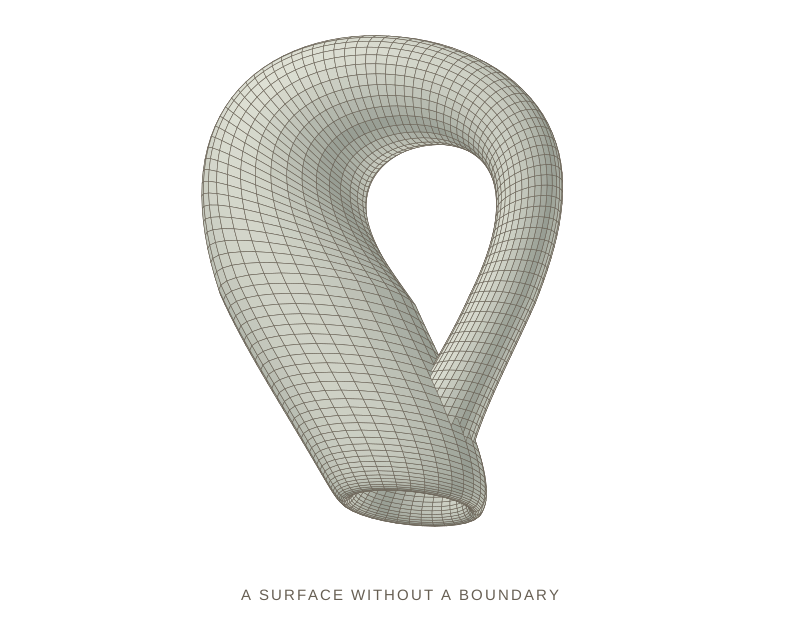
A representation in 3D: the crossing belongs to the model, not the abstract surface.
03 / Closed non-orientable surface
Klein bottle
The one-sided idea of a Möbius strip, with no boundary left over.
A Klein bottle is a closed, non-orientable surface. Join two Möbius strips along their boundaries and you obtain its topology. The familiar bottle-shaped representation sends a neck through the body and reconnects it to the surface. That crossing is needed to represent it in three dimensions; it is not a junction in the mathematical surface.
Can it exist? It is a valid two-dimensional surface. It can sit in four-dimensional space without crossing itself, but cannot do so in three-dimensional space. Glass versions represent the idea with a crossing or a modified connection.
A WAY TO UNDERSTAND IT
Imagine a tiny traveller walking along the surface, staying on the same sheet at the crossing. It can reach what looks like the opposite side without stepping across a boundary. Unlike the Möbius strip, there is no edge to trace.
Introduced by Felix Klein in 1882. The surface itself is two-dimensional; four dimensions are needed to embed it without intersections.
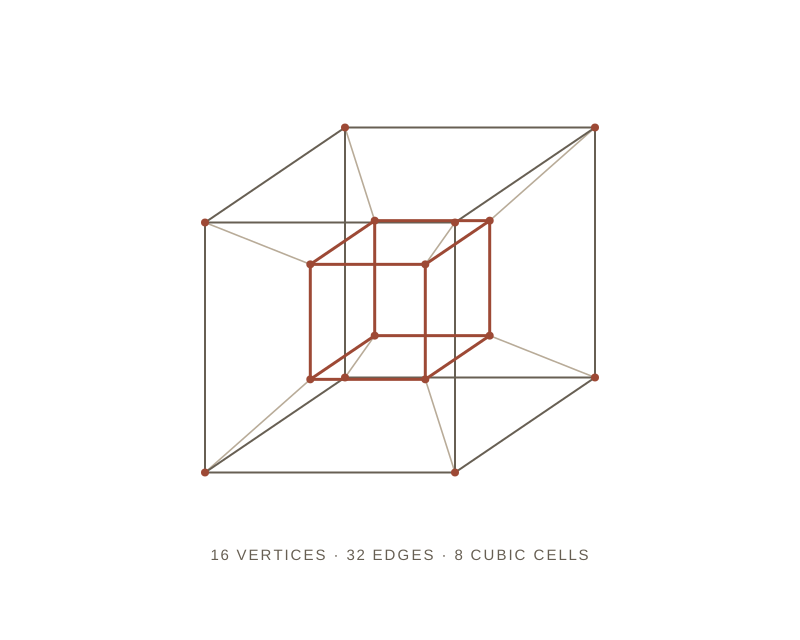
A projection: the apparent inner and outer cubes are the same size in 4D.
04 / Four-dimensional cube
Tesseract
Take the step from square to cube once more, in a new spatial direction.
Move a square in a direction outside its plane to make a cube. Move a cube along a fourth independent spatial direction and you make a tesseract. It has 16 vertices, 32 edges, 24 square faces, and eight cubic cells. A projection compresses that geometry, just as a drawing of a cube compresses depth onto paper.
Can it exist? Yes, as a mathematical object in four spatial dimensions. A physical wire model shows a projection, with distorted lengths and angles.
A WAY TO UNDERSTAND IT
Look at the two cubes and the eight lines joining their matching corners. Imagine the nested cubes as two copies separated along a direction you cannot point to in our space. Their apparent difference in size is an effect of the projection.
Also called the four-dimensional hypercube, or 4-cube. Its extra direction is spatial, rather than time.
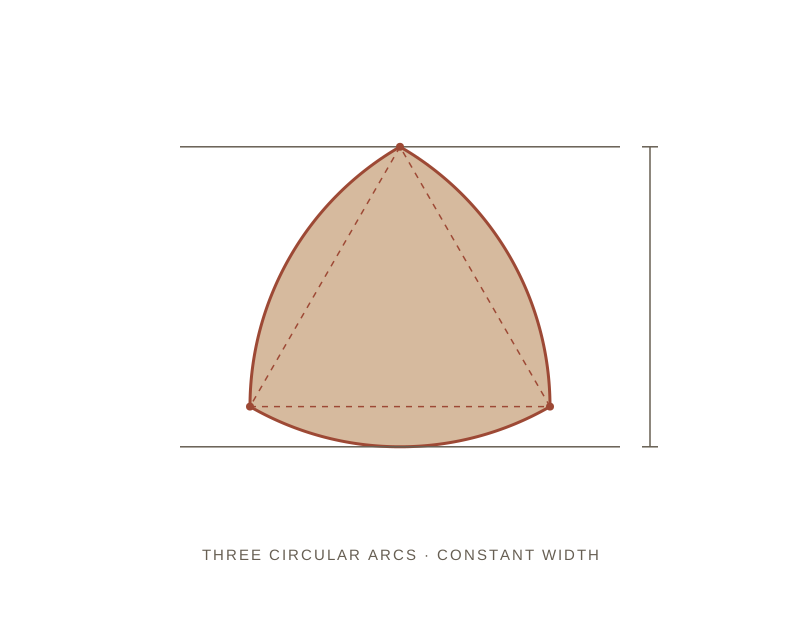
The same distance between parallel supports, in every orientation.
05 / Curve of constant width
Reuleaux triangle
A shape with corners that keeps the same width as it turns.
Start with an equilateral triangle. From each vertex, draw the circular arc joining the other two vertices. The curved outline has constant width: any pair of parallel lines touching it on opposite sides stays the same distance apart, whatever their direction. Constant width does not require a circle or a constant distance from the centre.
Can it exist? Yes. Cut it from a flat sheet, or make a prism with this cross-section. Its centre moves up and down as it rolls, even though the gap between parallel supports stays constant.
A WAY TO UNDERSTAND IT
Draw the three arcs with a compass set to the triangle’s side length. Cut out the shape and turn it between two parallel rulers. Keep the rulers just touching the outline and compare the gap at different angles.
Named after nineteenth-century engineer Franz Reuleaux, although the shape was known earlier.
A Möbius strip is a surface made by joining the ends of a strip with a half twist. It has one continuous side and one continuous boundary, which you can explore with a paper model.
Can a Klein bottle exist in three dimensions?
The mathematical surface cannot be embedded in ordinary three-dimensional space without intersecting itself. Familiar glass models show a crossing; a faithful embedding needs a fourth spatial dimension.
What is a tesseract?
A tesseract is the four-dimensional analogue of a cube. Drawings and models in three dimensions show projections, rather than its full four-dimensional geometry.