Instructions
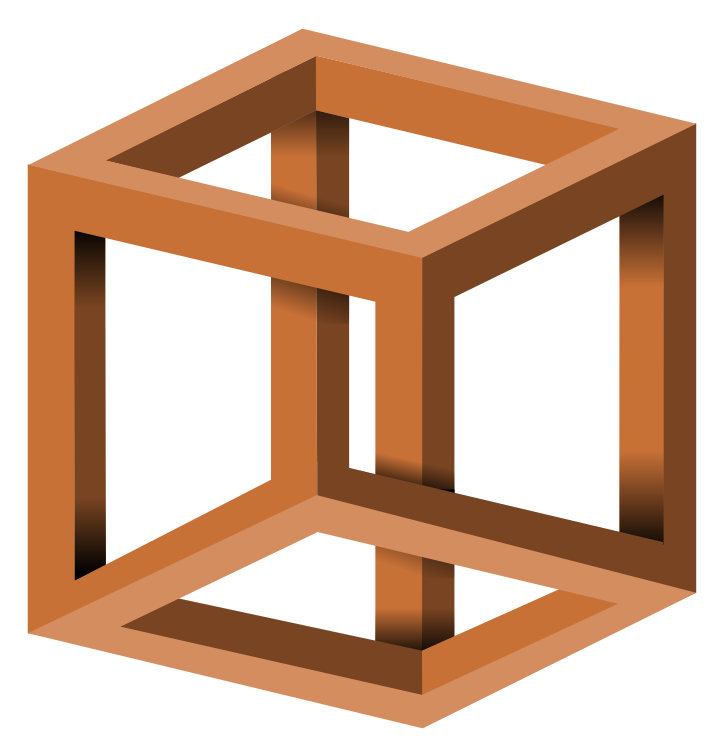
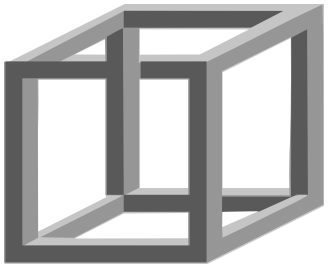
Note how parts of the cube seem to be simultaneously in front of and behind other parts of the cube.
Effect
You will see something which appears physically possible yet which you know is not.
Illusion credit
Maurits Cornelis Escher (1898 - 1972), Dutch graphic artist.
The Impossible Cube Figure was created by Maurits Cornelis Escher (1898 - 1972), a Dutch graphic artist, as part of his lithograph print Belvedere, which contains a variety of impossible figures. Belvedere was created in 1958, and the original version is now in the National Gallery of Canada, in Ontario.
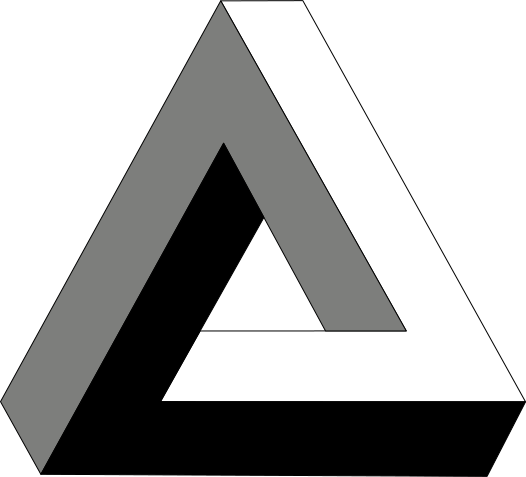
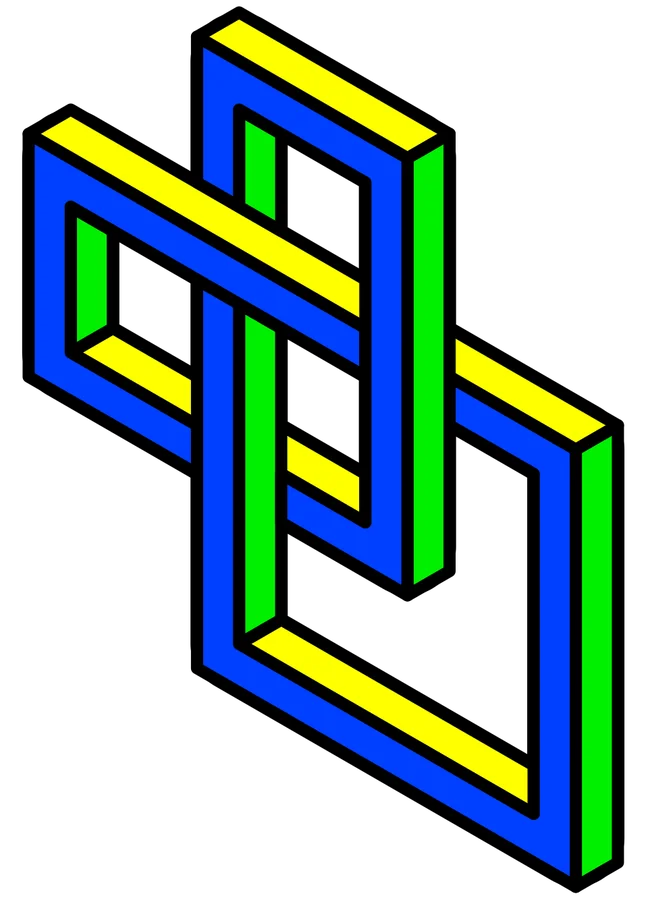
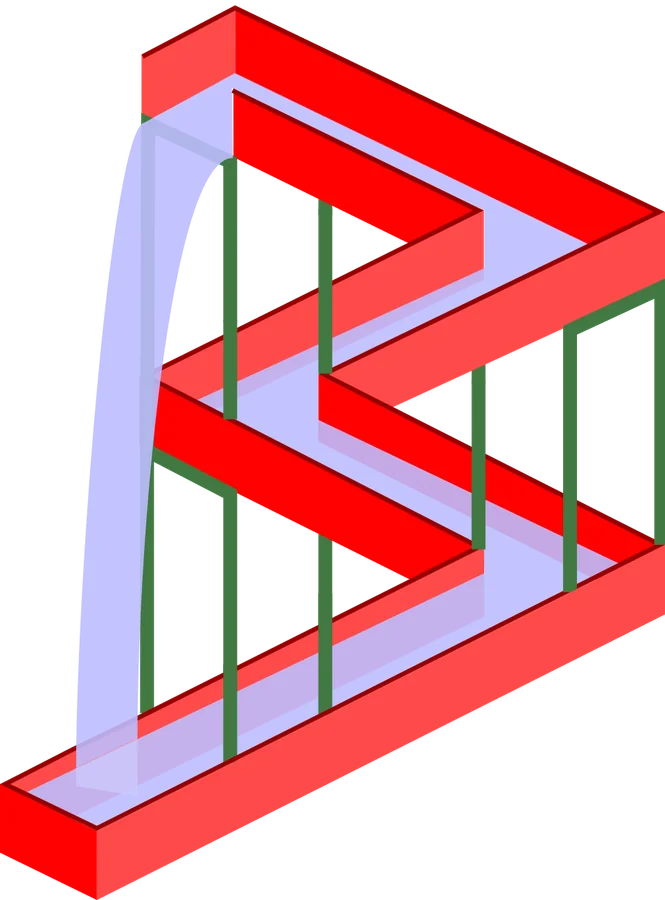
The Impossible Cube is an impossible figure (or impossible object or undecidable figure): it depicts an object which could not possibly exist. It’s impossible for the Impossible Cube to exist because in order for it to exist rules of Euclidean geometry would have to be violated. For example, parts of the cube are represented as being simultaneously at the front and the back of the cube. You can find other impossible figures by searching in the Illusions Index.
Escher and other artists such as Oscar Reutersvärd have frequently used impossible figures of varying types in their work, and mathematicians have studied the mathematical and computational properties of impossible figures to try and develop formulas and algorithms for modelling impossible objects, for use in such things as computer vision.
Cognitive scientists have been interested in the processes involved in continuing to see impossible figures as possible even when we know them to be impossible. Why, for instance, do we not see the Impossible Cube just as some lines on a page once we realise that it can’t exist in three-dimensional space? In answering this question, debates about modularity and cognitive penetration are of central importance. To explain: on the hypothesis that the mind is modular, a mental module is a kind of semi-independent department of the mind which deals with particular types of inputs, and gives particular types of outputs, and whose inner workings are not accessible to the conscious awareness of the person – all one can get access to are the relevant outputs. So, in the case of impossible figures, a standard way of explaining why experience of the impossible figure persists even though one knows that one is experiencing an impossibility is that the module, or modules, which constitute the visual system are ‘cognitively impenetrable’ to some degree – i.e. their inner workings and outputs cannot be influenced by conscious awareness.
Philosophers have also been interested in what impossible figures can tell us about the nature of the content of experience (Macpherson 2010). For example, impossible figures seem to provide examples of experiences with content that is contradictory, which some philosophers have taken to count against the claim that perceptual states are belief-like because if they were, when experiencing the Impossible Cube, one would simultaneously believe that such as figure could exist and that it could not. This would seem to entail that one was being irrational, because one would simultaneously be holding contradictory beliefs. But it seems highly implausible that one is being irrational when undergoing this illusion. For discussion of this general point about whether perceptions are like beliefs, see Crane & French (2016).
References
Macpherson, F., 2010. Impossible Figures. In Goldstein, E. B. ed., Sage Encyclopedia of Perception. Sage Publications, Inc.
Escher, M. C. 1958. Belvedere. Ontario: National Gallery of Canada. Print.
Article links
Media & demonstrations
Open source links to use interactive demonstrations and embedded recordings. Source media credits and license labels are reproduced as supplied.
Source license label: Public Domain.
Source credit: https://wpclipart.com/signs_symbol/optical_illusions/impossible_objects/impossible_cube.png.html
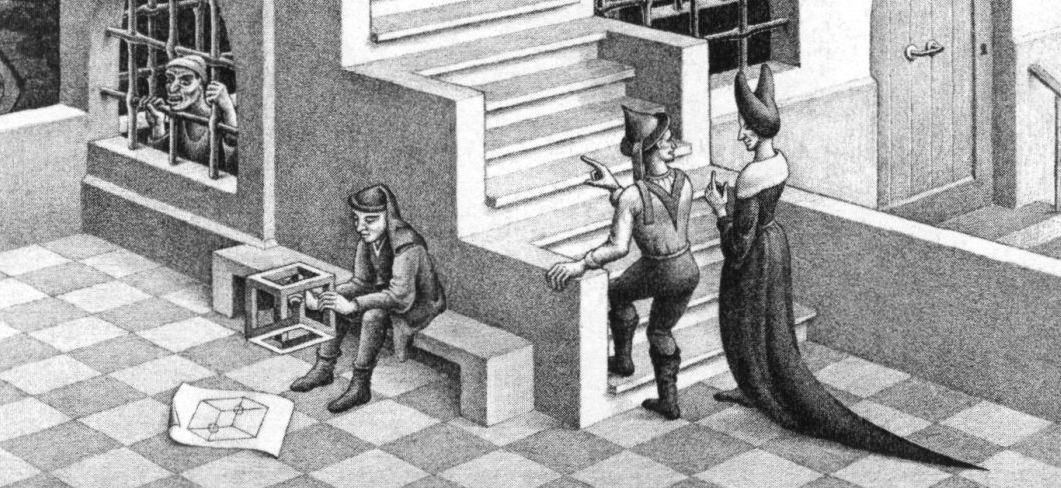
An impossible cube from Escher's Belvedere ↗
Source license label: Attribution-NonCommercial-NoDerivs.
Source credit: Escher, M. C. 1958. Belvedere. Ontario: National Gallery of Canada. Print.
Photo of an object that from the right angle looks like an impossible cube ↗
Source license label: © Copyright 2012 BrainDen.com.
Source credit: http://brainden.com/impossible-objects.htm
Photo of a sculpture that from the right angle looks like an impossible cube ↗
Source license label: © Copyright Okami No Ti.
Source credit: http://www.fotocommunity.com/photo/i-buy-the-new-escher-objectiv-okami-no-ti/13176876