Instructions
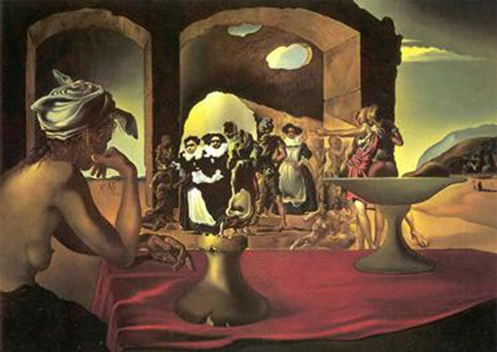
Look at the centre of the image. If you see the bust of Voltaire, focus on the eyes, and they should appear as heads of two women. If you don't see the bust, imagine the heads of the women in black and white to be eyes, and you should see the bust.
Effect
You should experience a 'Gestalt switch' - a change - between experiencing the centre figure in the image as a bust and as people.
Illusion credit
Salvador Dali (1904 - 1989), Spanish surrealist artist
The Disappearing Bust of Voltaire was created by Salvador Dali in 1940. The painting can be seen as group of characters and an arch opening in the wall when the image is viewed up-close, or as Voltaire’s head when it is viewed from afar (Oliva, 2013).
The Disappearing Bust of Voltaire belongs in a large class of illusions where a two-dimensional figure, or three-dimensional object can be seen in two or more sharply distinct ways. There are many examples of ambiguous figures which you can search for in this illusions index.
There is some controversy over how the Disappearing Bust of Voltaire ambiguous figure works. It is generally agreed that the retinal image is constant when experiencing the illusion, but what is not agreed is whether the visual experience of the figure changes when the perspectival switch takes place between seeing the group of characters versus Voltaire’s head, or whether the experience itself does not change, and it is some post-experiential belief, judgment, or other mental process which changes. Similar ambiguous figures have been cited in debates over this issue (Silins 2015: §2.4).
This issue is intertwined with more general questions about the modularity of mind and cognitive penetration. To explain: on the hypothesis that the mind is modular, a mental module is a kind of semi-independent department of the mind which deals with particular types of inputs, and gives particular types of outputs, and whose inner workings are not accessible to the conscious awareness of the person – all one can get access to are the relevant outputs. So, in the case of visual illusions, for example, a standard way of explaining why the illusion persists even though one knows that one is experiencing an illusion is that the module, or modules, which constitute the visual system are ‘cognitively impenetrable’ to some degree – i.e. their inner workings and outputs cannot be influenced by conscious awareness. It is still an open question regarding the extent to which perceptual modules are cognitively impenetrable, and the Disappearing Bust of Voltaire belongs in a large class of illusions which are employed in debates to try and close that question. One way in which ambiguous figures like the Man and Girl might support the claim that visual processing is impenetrable to a significant degree is that the Gestalt switch is hard to control – often one will see the Disappearing Bust of Voltaire one way or another even if one is trying to see it the other way. Macpherson discusses this phenomenon and its implications in her 2012 paper. Further, there is some evidence from neuroscience that, for at least some ambiguous figures, there are significant changes in early-stage visual processing in the brain when the Gestalt switch is taking place, which might support the hypothesis that Gestalt switches in general are changes in the experience itself rather than in downstream mental processes like beliefs about that experience (see Kornmeier & Bach 2006, 2012).
Finally, ambiguous figures like the Disappearing Bust of Voltaire have been cited in debates about whether the nature of experience can be fully accounted for by appealing only to its representational content. Some philosophers and cognitive scientists distinguish between the phenomenal character of an experience – i.e. what it is like for a conscious subject to undergo that experience – and its representational content – i.e. what the experience is about. Some philosophers, known as ‘representationalists’ argue that the phenomenal character of experience can be accounted for fully in terms of the representational content of experience. One motivation for this argument is that representational content seems easier to ‘naturalise’ – i.e. for its nature to be explained in purely materialist terms by appealing solely to physical entities like brain states. Phenomenal character, on the other hand, seems much more resistant to attempts to naturalise it. But if phenomenal character can be fully accounted for in representationalist terms, then this would make the naturalising of phenomenal character seem much more tractable. And ambiguous figures are among the key examples discussed in debates about whether phenomenal character can be fully accounted for in representationalist terms. For example, Macpherson (2006) has argued that the changes in phenomenal character that occur when the Gestalt switch takes place while experiencing an ambiguous figure cannot be explained in naturalistic, representationalist terms. Macpherson’s 2006 paper provides an overview of the general debate and its many moving parts.
References
Kornmeier, J. and Bach, M., 2005. The Necker cube—an ambiguous figure disambiguated in early visual processing. Vision research, 45(8), pp.955-960.
Kornmeier, J. and Bach, M., 2012. Ambiguous figures–what happens in the brain when perception changes but not the stimulus. Frontiers in human neuroscience, 6.
Necker, L.A., 1832. Observations on some remarkable optical phaenomena seen in Switzerland; and on an optical phaenomenon which occurs on viewing a figure of a crystal or geometrical solid. London and Edinburgh Philosophical Magazine and Journal of Science.
Silins, N., 2015. Perceptual Experience and Perceptual Justification. In: Zalta, E. N., ed. The Stanford Encyclopedia of Philosophy. Metaphysics Research Lab, CSLI, Stanford University.
Macpherson, F., 2006. Ambiguous figures and the content of experience. Noûs 40 (1):82-117.
Macpherson, F., 2012. Cognitive penetration of colour experience: Rethinking the issue in light of an indirect mechanism. Philosophy and Phenomenological Research, 84(1), pp.24-62.
Oliva, A. 2013. The Art of Hybrid Images: Two for the View of One. Art & Perception, 1 (1-2), pp.65-74.
Media & demonstrations
Open source links to use interactive demonstrations and embedded recordings. Source media credits and license labels are reproduced as supplied.
Source license label: Attribution-NonCommercial-NoDerivs.
Source credit: https://en.wikipedia.org/wiki/Slave_Market_with_the_Disappearing_Bust_of_Voltaire