Instructions
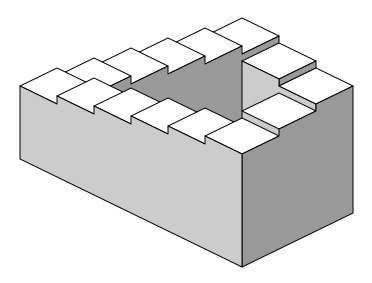
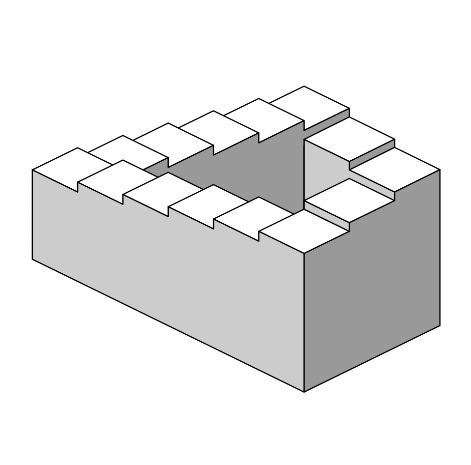
Note how the stairs appear to continuously ascend when tracing round their path in one direction and descend in the other, yet if one were to complete a circuit one would end up back at the same level that one began.
Effect
You will see something which appears physically possible yet which you know is not.
Illusion credit
Oscar Reutersvärd (1915 - 2002), a Swedish graphic artist, and independently, Lionel Sharples Penrose (1898 -1972), British psychiatrist, geneticist, and mathematician, and his son, Sir Roger Penrose (1931 -), a mathematician, physicist and philosopher of science.
Escher's Ascending and DescendingLicence: Fair Use;source
Impossible Staircase by Oscar Reutersvard;Licence: Public Domain;sourceImpossible Staircase by Oscar Reutersvard;Licence: Public Domain;source
The Penrose Stairs Figure was created by Lionel Sharples Penrose (1898 -1972), a British psychiatrist, geneticist, and mathematician, and his son Sir Roger Penrose (1931 -), a British mathematician, physicist and philosopher of science. It was first published in the British Journal of Psychology in 1958.
Shortly afterwards, in 1960, Escher produced his lithograph print Ascending and Descending, which contained such a staircase. Penrose and Penrose cited Escher's work as part of their inspiration for creating the staircase and sent a copy of their paper to Escher. Escher subsequently wrote back to Penrose and Penrose (see Ernst 1992):
A few months ago, a friend of mine sent me a photocopy of your article... Your figures 3 and 4, the 'continuous flight of steps', were entirely new to me, and I was so taken by the idea that they recently inspired me to produce a new picture, which I would like to send to you as a token of my esteem.
However, an impossible staircase was first created many years earlier, in 1937, by Oscar Reutersvärd - unbeknown to the Penroses and Escher.
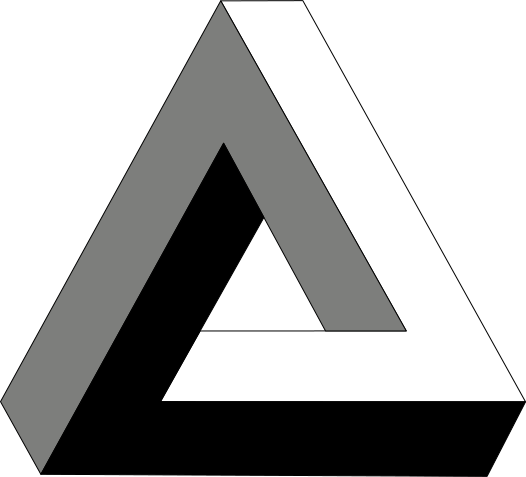
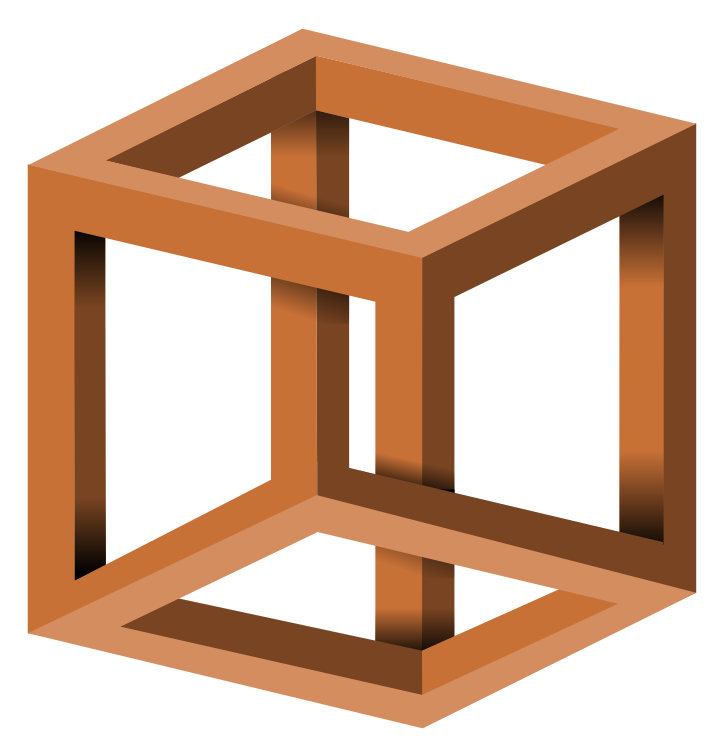
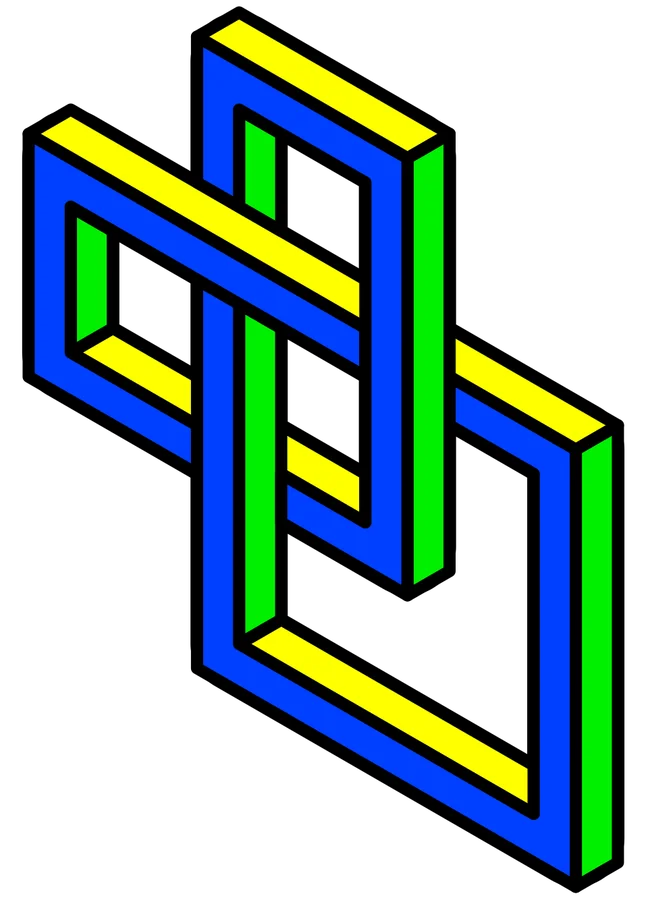
The Penrose Stairs is an impossible figure (or impossible object or undecidable figure): it depicts an object which could not possibly exist. It is impossible for the Penrose Stairs to exist because in order for it to exist rules of Euclidean geometry would have to be violated. For example, if one were to complete a circuit of the stairs, one would end up back at the same level that one began, even though each flight of the stairs continuously rise (or fall, depending on the direction of travel). It is one of many types of impossible figures which you can search for in the Illusions Index.
Artists such as Oscar Reutersvärd and M. C. Escher have frequently used impossible figures of varying types in their work, and mathematicians have studied the mathematical and computational properties of impossible figures to try and develop formulas and algorithms for modelling impossible objects, for use in such things as computer vision. Cognitive scientists have been interested in the processes involved in continuing to see impossible figures as possible even when we know them to be impossible. Why, for instance, do we not see the Penrose Stairs simply as some lines on a page once we realise that it can’t exist in three-dimensional space? In answering this question, debates about modularity and cognitive penetration are of central importance To explain: on the hypothesis that the mind is modular, a mental module is a kind of semi-independent department of the mind which deals with particular types of inputs, and gives particular types of outputs, and whose inner workings are not accessible to the conscious awareness of the person – all one can get access to are the relevant outputs. So, in the case of impossible figures, a standard way of explaining why experience of the impossible figure persists even though one knows that one is experiencing an impossibility is that the module, or modules, which constitute the visual system are ‘cognitively impenetrable’ to some degree – i.e. their inner workings and outputs cannot be influenced by conscious awareness.
Philosophers have also been interested in what impossible figures can tell us about the nature of the content of experience. For example, impossible figures seem to provide examples of experiences with content that is contradictory, which some philosophers have taken to challenge the claim that perceptual states are belief-like (Macpherson 2010). They also prove problematic for sense-data accounts of perception that posit that corresponding to every experience that we have there are mental objects that we are aware of that have the properties that the objects that our experiences tell us they do. They problem is that sense-data would have to be impossible objects. But surely, impossible objects can't exist!
References
Ernst, Bruno (1992). The Eye Beguiled: Optical Illusions. Cologne: Taschen.
Macpherson, F., 2010. Impossible Figures. In Goldstein, E. B. ed., Sage Encyclopedia of Perception. Sage Publications, Inc.
Penrose, L. S. and Penrose, R., 1958. Impossible objects: A special type of illusion. British Journal of Psychology, 49, pp.31-33.
Wikipedia contributors (23 April 2017). Oscar Reutersvärd', Wikipedia, The Free Encyclopedia, https://en.wikipedia.org/w/index.php?title=Oscar_Reutersv%C3%A4rd&oldid=776815917
Article links
- source ↗
- source ↗
- source ↗
- https://en.wikipedia.org/w/index.php?title=Oscar_Reutersv%C3%A4rd&oldid=776815917 ↗
Media & demonstrations
Open source links to use interactive demonstrations and embedded recordings. Source media credits and license labels are reproduced as supplied.
Source license label: Attribution-NonCommercial-NoDerivs.
Source license label: Not specified for this media item.
Source license label: Not specified for this media item.
Source license label: Not specified for this media item.