Instructions
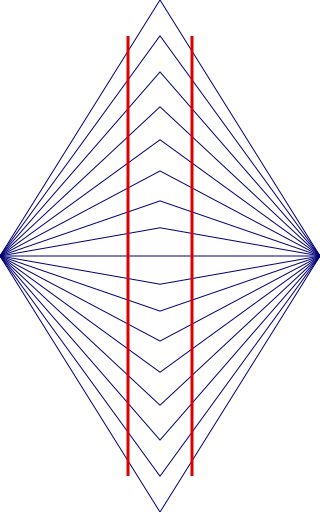
Look at the red lines and see if they seem parallel or curved inwards.
Effect
The lines appear to be curved inwards, although they are really parallel.
Illusion credit
Wilhelm Maximilian Wundt (1832 - 1920), German physician who was one of the founding figures of modern psychology.
The Wundt Illusion was created by Wilhelm Maximilian Wundt (1832 - 1920), a German physician who was one of the founding figures of modern psychology. (A short overview of Wundt’s contributions to psychology can be found in Wade, Sakurai, & Gyoba 2007). Wundt first published the illusion in the journal Abhandlungen der Mathematisch-Physischen Klasse der Königlich-Sächsischen Gesellschaft der Wissenschaften in 1898.
The Wundt Illusion is one among a number of illusions where a central aspect of a simple line image – e.g. the length, straightness, or parallelism of lines – appears distorted by other aspects of the image – e.g. other background/foreground lines, or other intersecting shapes. These are sometimes called ‘geometrical-optical illusions’. You can search for other geometrical illusions in the Illusions Index. The Wundt Illusion is especially similar to the Hering Illusion, as each is an inverted version of the other.
There are a number of general hypotheses about why we experience the Wundt illusion. One is that our perceptual systems have a tendency to ‘expand’ acute angles—that is to represent them as larger angles than they really are. In the case of the Wundt Illusion, the blue radial lines which intersect the vertical red lines cause the visual system to enhance the orientation contrast between the red and blue lines – to ‘expand’ the acute angles at the point of intersection between the blue and red lines. This, in turn, causes the appearance of the red lines bending inwards near the centre (for a detailed discussion of the phenomenon of acute angle expansion, see Westheimer 2008).
The Wundt Illusion is interesting because it is relevant to debates about modularity, cognitive penetration, and the nature of experience. To explain: on the hypothesis that the mind is modular, a mental module is a kind of semi-independent department of the mind which deals with particular types of inputs, and gives particular types of outputs, and whose inner workings are not accessible to the conscious awareness of the person – all one can get access to are the relevant outputs. So, in the case of the Wundt Illusion, a standard way of explaining why experience of the illusion persists even though one knows that one is experiencing an illusion is that the module, or modules, which constitute the visual system are ‘cognitively impenetrable’ to some degree – i.e. their inner workings and outputs cannot be influenced by conscious awareness. For a general discussion of cognitive penetration, see Macpherson (2012).
Philosophers have also been interested in what illusions like the Wundt Illusion can tell us about the nature of experience. For example, in the case of experiencing the Wundt Illusion, it would seem to be that the one can know that the vertical red lines are straight whilst at the same time experiencing them as curved. If so, then this might count against the claim the perceptual states are belief-like, because if perceptual states were belief-like then, when experiencing the Wundt Illusion, one would simultaneously believe that the lines were straight and not straight at the same time. This would seem to entail that one was being irrational when experiencing the Wundt Illusion (because one would simultaneously be holding contradictory beliefs). But it seems highly implausible that one is being irrational when undergoing this illusion. For discussion of this general point about whether perceptions are like beliefs, see Crane & French (2016).
References
Crane, T., and French, C., 2016. The Problem of Perception. In: Zalta, E. N., ed. The Stanford Encyclopedia of Philosophy. Metaphysics Research Lab, CSLI, Stanford University.
Eagleman, D.M., 2001. Visual illusions and neurobiology. Nature Reviews Neuroscience, 2(12), pp.920-926.
Macpherson, F., 2012. Cognitive penetration of colour experience: Rethinking the issue in light of an indirect mechanism. Philosophy and Phenomenological Research, 84(1), pp.24-62.
Wade, Nicholas J., Kenzo Sakurai, and Jiro Gyoba. "Whither wundt?." Perception 36.2 (2007): 163-166.
Wundt., W., 1898. Die geometrisch-optischen Tauschungen. Abhandlungen der Mathematisch-Physischen Klasse der Königlich-Sächsischen Gesellschaft der Wissenschaften, 42, pp.55- 178.
Westheimer, G., 2008. Illusions in the spatial sense of the eye: Geometrical–optical illusions and the neural representation of space. Vision research, 48(20), pp.2128-2142.
Article links
Media & demonstrations
Open source links to use interactive demonstrations and embedded recordings. Source media credits and license labels are reproduced as supplied.
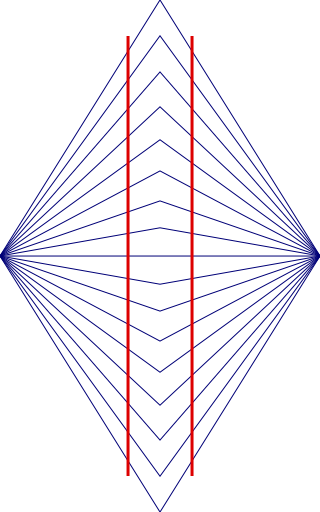
The two red vertical lines appear to be curved inwards, despite actually being straight. ↗
Source license label: Attribution-NonCommercial-NoDerivs.